The four horsemen symbolize a connected sequence of conquest, warfare, economic distress, and mass death released as the Lamb opens the first four seals in Revelation 6. The white rider’s identity remains disputed, while the red, black, and pale horses are closely tied to violence, scarcity, and mortality. Their imagery draws on Zechariah’s colored horses and reflects covenant-judgment language found elsewhere in Scripture. Readers should interpret the riders as a coordinated vision rather than four unrelated predictions, distinguish what Revelation states from later speculation, and avoid forcing every war, famine, epidemic, or political leader into a one-to-one prophetic identification.
Where the Four Horsemen Appear in Revelation
The four horsemen enter the vision when the Lamb opens the first four seals of a seven-sealed scroll in Revelation 6:1–8. Each opening is followed by a summons from one of the four living creatures, and a horse of a different color appears. The riders are therefore not independent figures wandering into the narrative. They belong to the Lamb’s opening of the scroll and to the larger sequence of seals, trumpets, and bowls that structures much of Revelation.
That setting changes how the symbolism should be handled. Revelation presents Jesus Christ as the slain yet victorious Lamb who is worthy to open the scroll in chapter 5. The horsemen do not surprise or overpower him. Their arrival occurs within a vision of divine authority, even though the events they represent are violent and destructive. Revelation’s emphasis is not that history has escaped control, but that judgment unfolds under limits established within the vision.
The imagery also has an older biblical background. Zechariah 1 describes mounted riders who patrol the earth, while Zechariah 6 presents colored horses pulling chariots sent toward different regions. Revelation reworks this prophetic vocabulary rather than reproducing it mechanically. Ezekiel 14:21 supplies another important connection by grouping sword, famine, wild beasts, and plague as severe judgments. Revelation 6:8 gathers similar agents under the authority given to Death and Hades.
A practical reading should begin with those textual relationships before turning to newspaper events, timelines, or proposed modern identities. A reader comparing Four horsemen symbolism in end-times prophecy with Zechariah and Ezekiel can see that the vision uses an established scriptural language of judgment. The common mistake is to treat the horses’ colors as a secret code detached from the actions, objects, and explanations supplied by the passage itself.
The first priority is therefore context: identify who opens the seals, who summons the riders, what each rider receives, and how the fourth rider summarizes the destructive effects. That approach does not settle every disputed detail, but it keeps interpretation anchored to features Revelation actually gives the reader.
What Each Horse and Rider Symbolizes
Each rider is distinguished by color, equipment, action, and outcome. Those details carry more interpretive weight than imaginative attempts to match the riders with particular nations, technologies, or personalities. The text gives explicit names only to the fourth rider, leaving the identities of the others to be inferred from their assigned roles.
The White Horse: Conquest or Counterfeit Victory
The first rider sits on a white horse, carries a bow, receives a crown, and goes out conquering. Some readers identify him positively with Christ or the advance of the gospel because Revelation later depicts Christ riding a white horse in chapter 19. Others see an agent of imperial conquest, militarism, or deceptive domination. The surrounding riders favor a negative reading: the first seal begins a destructive progression that leads through war and scarcity to death.
The comparison with Revelation 19 must still be taken seriously, but similarity does not require identity. The chapter 19 rider is explicitly called Faithful and True, bears many crowns, and is named the Word of God. Revelation 6 gives its rider a granted crown and describes his activity without naming him. A responsible conclusion acknowledges the debate while recognizing conquest as the clearest function stated in the passage.
The Red, Black, and Pale Horses
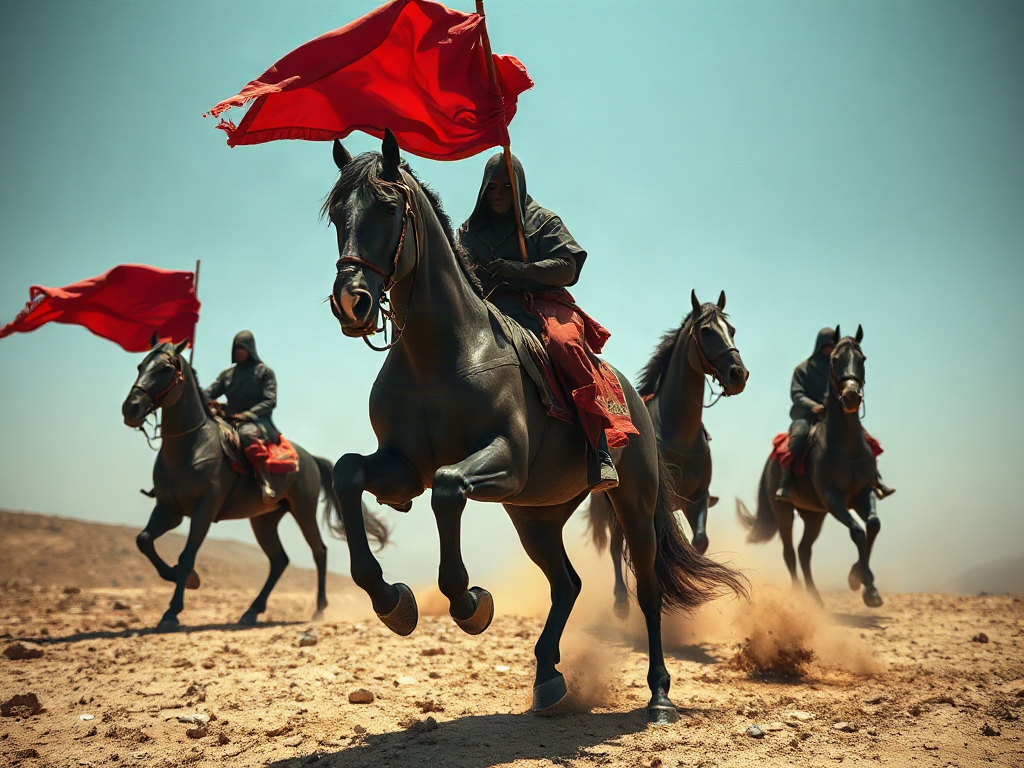
The fiery red horse represents bloodshed and the removal of peace. Its rider receives a great sword, and people turn against one another. The emphasis extends beyond a single battle; it depicts social and military violence spreading once peace is taken away.
The black horse brings measured food and inflated prices. Its rider holds scales, while a voice announces the cost of wheat and barley. The scene suggests scarcity severe enough to make staple food expensive, although the command not to harm the oil and wine shows that the shortage is constrained or uneven. That detail warns against reducing the image to total global starvation. It may portray an economy in which basic necessities become inaccessible while selected goods remain available.
The pale horse has the sickly green-gray color associated with decay. Its rider is named Death, Hades follows, and authority is given to kill through sword, famine, pestilence, and wild animals. Here the symbolism becomes explicit. Rather than assigning every modern crisis to a separate horse, readers should notice how conquest destabilizes peace, violence damages production and distribution, scarcity weakens populations, and death gathers the results.
Why the Riders Appear in a Deliberate Sequence
The sequence presents compounding judgment rather than four isolated disasters. Conquest initiates domination, the red horse removes peace, the black horse depicts the economic consequences of disorder, and the pale horse gathers multiple causes of mortality. Revelation does not provide a technical model of social collapse, but the order resembles patterns repeatedly seen when aggression disrupts civil life.
Consider a limited historical scenario without claiming it fulfills the prophecy: an invading power seizes territory, armed conflict interrupts planting and transport, staple prices rise, and malnutrition or disease increases deaths. That chain illustrates why the riders belong together. It does not prove that any particular conflict is the definitive opening of the seals. The vision’s theological claim is larger than a single example, and its symbols can evoke recurring realities while still pointing toward climactic judgment.
The repeated phrase that authority “was given” places limits around the riders. The black horse’s announcement specifies prices and preserves oil and wine. The fourth rider receives authority over a fourth of the earth, not unrestricted power over everything. Such boundaries matter because popular treatments sometimes portray the horsemen as autonomous supernatural forces. Within Revelation, they act only as the seals are opened and within authority granted to them.
The progression also guards against overly narrow identifications. Equating the black horse solely with one recession, for example, ignores its position between warfare and death. Equating the pale horse with one disease ignores the four modes of death listed in the verse. Sound interpretation asks how each sign contributes to the whole scene before asking whether a contemporary event resembles one feature.
Readers examining Four horsemen symbolism in end-times prophecy should track three kinds of connections: the literary movement within Revelation 6, the earlier prophetic imagery behind it, and the cause-and-effect relationship among conquest, conflict, scarcity, and mortality. An interpretation is working when it accounts for all three. It is failing when it depends mainly on a horse’s color, an isolated headline, or an unexplained resemblance to a modern symbol.
How Major Interpretive Views Read the Horsemen
Interpretive traditions agree more readily about the riders’ destructive themes than about when the seals unfold. The main approaches differ because they understand Revelation’s relationship to the first century, church history, recurring human conditions, and the final crisis in different ways.
Preterist readings connect much of the imagery to conditions known by Revelation’s earliest audiences, including Roman power, warfare, food insecurity, persecution, and judgment surrounding first-century events. This approach gives substantial weight to the book’s original recipients and its claim that they were to hear and keep its message. Its limitation appears when an interpretation treats the vision as exhausted by one ancient episode despite Revelation’s universal and consummative scope.
Historicist readings map the seals and other visions across successive periods of church and imperial history. This can highlight long historical patterns, but proposed timelines often vary sharply. If an interpretation requires highly selective dates or repeatedly changes its identifications as history advances, its explanatory value weakens.
Futurist readings place the horsemen mainly in a final period of tribulation. This view preserves the escalating, climactic character of the seals and is common in popular end-times teaching. The chief risk is premature certainty: current leaders, treaties, wars, currencies, or public-health emergencies may be assigned prophetic identities before the full textual pattern is present.
Idealist or symbolic readings see the riders as recurring forces of conquest, violence, deprivation, and death throughout the age. This approach explains why the vision remains recognizable across cultures and centuries. Taken alone, however, it can flatten Revelation’s forward movement toward final judgment and renewal.
Readers do not need to pretend these differences are trivial, but they can test each proposal consistently. Ask whether it respects the first-century audience, preserves the sequence of the seals, accounts for Old Testament allusions, and allows Revelation’s story to reach its promised conclusion. A balanced interpretation may recognize recurring patterns without declaring every recurrence the final fulfillment. The mistake to avoid is choosing a framework because it offers the most detailed chart; detail is not evidence unless the textual links support it.
A Text-Based Method for Evaluating Prophetic Claims
A disciplined evaluation separates the wording of Revelation from conclusions imported into it. This is especially useful when a teacher, video, or social post claims that one horseman has appeared in a recent event. The question is not whether the event is serious. The question is whether the proposed identification explains the complete passage better than alternative readings.
Use this compact checking sequence:
- Read the whole seal scene. Include Revelation 5 and the remainder of chapter 6 so the Lamb, scroll, martyrs, cosmic disturbance, and approaching wrath remain visible.
- Record explicit details. Note colors, objects, actions, spoken announcements, granted authority, limits, and named figures before assigning meanings.
- Compare biblical backgrounds. Examine Zechariah 1 and 6, Ezekiel 14, and relevant judgment imagery rather than relying only on modern associations.
- Test the entire sequence. A credible interpretation should explain the relationship among conquest, war, food scarcity, and death—not merely one striking similarity.
- Label the level of confidence. Distinguish direct statements, strong inferences, disputed possibilities, and unsupported speculation.
Suppose someone identifies the white horse with a named political leader because the leader promises peace while seeking power. The proposal may echo the conquest or deception interpretation, but Revelation 6 does not name a nationality, office, treaty, or individual biography. Without stronger textual correspondence, the identification should remain speculation. The same caution applies when commodity prices rise: expensive grain resembles the black horse’s imagery, but ordinary inflation by itself does not establish that the third seal has opened.
A useful interpretation makes the passage clearer without requiring hidden data that the original audience could never recognize. It should also survive comparison with competing views. If the claim works only after disregarding Zechariah, separating one rider from the other three, or converting every symbol into a precise modern object, the method is driving the conclusion.
The best next step is to annotate the passage using the checklist, then compare two or three serious commentaries representing different approaches. That process helps readers study Four horsemen symbolism in end-times prophecy without confusing watchfulness with certainty. Responsible vigilance notices meaningful patterns while leaving unconfirmed identities unconfirmed.
Frequently Asked Questions
Who are the four horsemen in Revelation?
They are four riders released when the Lamb opens the first four seals in Revelation 6. Their actions represent conquest, the removal of peace, food scarcity, and death through several forms of judgment.
Is the rider on the white horse Jesus or the Antichrist?
The text does not name him. Some identify him with Christ or gospel victory, while others see conquest, deceptive power, or an antichrist figure. His placement among destructive riders supports a negative reading, but the identity remains disputed.
Do the four horsemen appear in a specific order?
Yes. Revelation orders them as white, red, black, and pale. The movement from conquest to warfare, scarcity, and death forms a coherent escalation rather than a random collection of disasters.
Have the four horsemen already been released?
The answer depends on the interpretive framework. Some readers connect them with first-century or recurring historical realities, while futurists place their primary fulfillment in a final tribulation. Revelation does not authorize confident identification from one current event alone.
What does the black horse’s oil and wine command mean?
The command suggests that scarcity is severe but limited or uneven. Staple grains become extremely expensive while oil and wine remain protected, possibly portraying unequal access, selective damage, or restraint within judgment.
Further Reading
Authoritative Sources
- Revelation 5–6
biblegateway.comThe complete scroll and seal context shows who releases the riders, what authority they receive, and how their appearance fits the larger vision
- Zechariah 1:7–17 and 6:1–8
biblegateway.comThese passages provide the clearest Old Testament background for colored horses sent throughout the earth
- Ezekiel 14:12–23
biblegateway.comEzekiel’s grouping of sword, famine, wild animals, and pestilence clarifies the fourfold judgment language used for the pale horse
- Revelation 19:11–21
biblegateway.comThe later white-horse rider offers an essential comparison when assessing the disputed identity of Revelation 6’s first rider
Conclusion
The horsemen should be read first as a unified seal vision governed by the Lamb, not as four detachable clues for decoding daily news. Their colors matter, but their equipment, commands, limits, sequence, and scriptural background provide firmer interpretive controls. Zechariah explains the horse imagery, Ezekiel illuminates the pale rider’s fourfold destruction, and Revelation itself links conquest with bloodshed, scarcity, and death.
Readers should compare major interpretive approaches without granting any one timeline more certainty than the text allows. Start by marking explicit details in Revelation 5–6, trace the Old Testament connections, and test whether a proposed fulfillment explains all four riders together. Treat modern parallels as possible illustrations unless the full textual case is present. That distinction preserves both watchfulness and interpretive honesty.