Euphrates River prophecy timing in Revelation belongs to two distinct points in the book’s judgment sequence, not to a stated calendar date. Revelation 9 places four bound angels at the Euphrates within the sixth trumpet, while Revelation 16 describes the river drying up during the sixth bowl to prepare a route for kings from the east. Readers should keep those scenes separate, follow their literary order, and compare interpretations without treating present river levels as a sufficient fulfillment test. The text emphasizes appointed judgment, military movement, demonic deception, and the approach of the final conflict rather than giving a date that can be calculated.
What you’ll learn
This guide covers the following practical points:
- The Two Euphrates Passages in Revelation — Revelation connects the Euphrates with judgment twice, but the passages describe different events.
- Timing Within Revelation’s Sequence — The clearest timing information is literary rather than calendrical.
- How Major Interpretive Approaches Read the Timing — Interpretive tradition determines how readers connect Revelation’s sequence to history.
- Do Modern River Conditions Fulfill the Prophecy? — Low water in the contemporary Euphrates does not by itself establish that Revelation 16:12 has been fulfilled.
The Two Euphrates Passages in Revelation
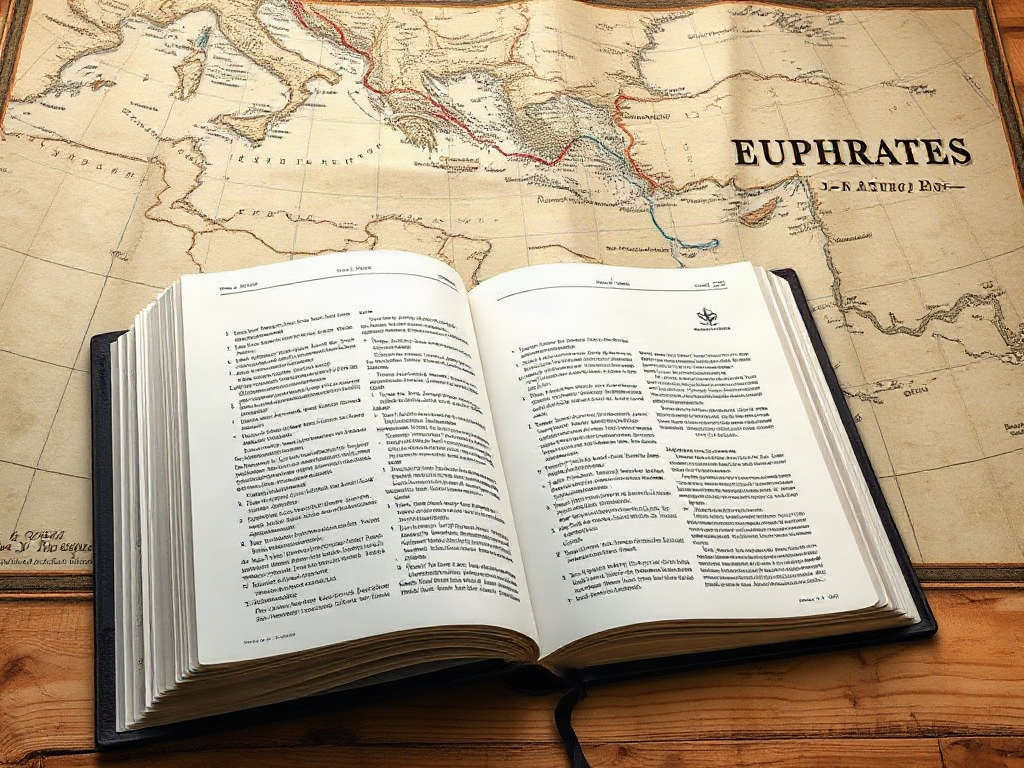
Revelation connects the Euphrates with judgment twice, but the passages describe different events. Revelation 9:13–21 concerns the sixth trumpet. A voice commands the release of four angels bound at the great river Euphrates, and the resulting vision includes an immense mounted force and widespread death. The river identifies the angels’ location; the passage does not say that its water disappears.
Revelation 16:12–16 belongs to the sixth bowl. Here the Euphrates is dried so that the way may be prepared for the kings from the east. The scene then shifts to unclean spirits gathering rulers for battle at the place called Armageddon. Drying, eastward kings, deceptive spirits, and the gathering for conflict form one connected sequence.
| Passage | Judgment Stage | Euphrates Detail | Immediate Result |
|---|---|---|---|
| Revelation 9:13–21 | Sixth trumpet | Four bound angels are released | A destructive mounted force advances |
| Revelation 16:12–16 | Sixth bowl | The river’s water is dried | The way is prepared and rulers gather for battle |
A common mistake is to merge these accounts into a single prediction about a physically shrinking river. Careful interpretation begins by identifying which passage a claim addresses and retaining the details that Revelation assigns to that scene.
Timing Within Revelation’s Sequence
The clearest timing information is literary rather than calendrical. Both Euphrates scenes occur at the sixth position in their respective judgment series. The trumpet scene follows the opening of the seventh seal and precedes the seventh trumpet. The bowl scene comes much later in the book’s presentation, after the beast-centered conflicts of chapters 12–14 and immediately before the seventh bowl.
That placement supports a relative timeline: Revelation 9’s event occurs within the trumpet cycle, while Revelation 16’s drying occurs near the culmination of the bowl cycle. Whether every vision must be read as strictly consecutive is debated. Some interpreters see the seals, trumpets, and bowls as a largely forward-moving chronology. Others see recapitulation, with later cycles revisiting the same age or final crisis at greater intensity.
Neither reading produces a calendar year from the Euphrates references. Revelation 9 says the angels were prepared for an hour, day, month, and year, language that stresses an appointed moment under divine control. It does not provide a starting date from which readers can calculate that moment. Attempts to turn the phrase into a countdown usually add assumptions absent from the text.
How Major Interpretive Approaches Read the Timing
Interpretive tradition determines how readers connect Revelation’s sequence to history. A futurist reading generally places the trumpets and bowls in a future period of severe judgment, often viewing the sixth bowl as closely preceding Christ’s return. Its strength is attention to the escalating sequence; its risk is attaching the text too quickly to a current military power or environmental report.
Preterist approaches relate much of Revelation to the first-century Roman world and the pressures facing its original churches. Idealist readings treat the visions primarily as recurring portrayals of divine judgment, political rebellion, deception, and conflict throughout the church age. Historicist readings have mapped the symbols onto extended eras of political and religious history, although proposed identifications vary considerably.
Readers comparing these positions should ask what each approach does with the passage’s complete context. A sound interpretation must account for the sixth judgment position, the angels in chapter 9, the kings and deceptive spirits in chapter 16, and the movement toward the book’s climax. An explanation that depends only on the modern river’s depth leaves most of that evidence untreated.
Do Modern River Conditions Fulfill the Prophecy?
Low water in the contemporary Euphrates does not by itself establish that Revelation 16:12 has been fulfilled. River levels can change through drought, dam operations, irrigation demand, seasonal variation, and regional water policy. Those conditions may make readers notice the passage, but resemblance to one feature is not the same as fulfillment of the entire scene.
Revelation 16 links the drying to a specific prophetic function: preparing the way for eastern kings as deceptive spirits gather the world’s rulers for battle. A responsible fulfillment claim would therefore need to address the passage as a unit, including its position under the sixth bowl and its relationship to the seventh bowl. A news report about exposed riverbanks does not establish those accompanying elements.
The opposite mistake is insisting that prophecy has no physical dimension because the book uses symbols. The Euphrates was a real and strategically significant river, while Revelation also employs imagery shaped by Israel’s Scriptures and ancient geography. The prudent conclusion is narrower: modern conditions may be relevant background, but the biblical text does not authorize a date prediction based on water measurements alone.
A Checklist for Evaluating Timing Claims
A strong timing claim should survive a passage-level check before it is connected to headlines. Use the following questions to identify whether an argument follows Revelation’s wording or relies mainly on speculation:
- Identify the passage: Is the claim about the four angels in Revelation 9 or the drying in Revelation 16?
- Locate the judgment: Does the explanation account for the sixth trumpet or sixth bowl?
- Keep the associated details: Are the kings, deceptive spirits, appointed judgment, and gathering for battle addressed where relevant?
- Separate sequence from date: Does the claim distinguish the event’s place in the vision from an unsupported calendar prediction?
- Test current-event claims: Is one modern condition being treated as proof while the rest of the passage is ignored?
This method does not settle every disagreement about Revelation’s structure. It does expose weak arguments. A reading is more credible when it explains the whole scene, states its interpretive assumptions, and acknowledges what the passage does not specify.
Conclusion
The timing question becomes clearer when Revelation 9 and Revelation 16 remain distinct. The first Euphrates scene belongs to the sixth trumpet; the second belongs to the sixth bowl and approaches the book’s climactic conflict. Readers should prioritize textual sequence, associated events, and stated interpretive assumptions over date calculations or single-feature headline comparisons. Current river conditions may prompt discussion, but they cannot carry a fulfillment claim without the broader prophetic context.
Frequently Asked Questions
When does the Euphrates prophecy occur in Revelation?
The Euphrates appears during the sixth trumpet in Revelation 9 and the sixth bowl in Revelation 16. These placements establish relative order within the visions, but they do not provide a calendar date.
Are Revelation 9 and Revelation 16 describing the same event?
The passages share the Euphrates setting but describe different actions. Chapter 9 releases four bound angels; chapter 16 dries the river and prepares a route for eastern kings.
Does Revelation predict that the Euphrates will dry up?
Revelation 16:12 explicitly says the river’s water is dried up. Interpretations differ over whether that language should be read physically, symbolically, or with both dimensions.
Do falling Euphrates water levels prove fulfillment?
No. Reduced flow matches only one surface feature of Revelation 16. The passage also includes the sixth bowl, kings from the east, deceptive spirits, and a worldwide gathering for battle.
Can the appointed hour in Revelation 9 be used to calculate a date?
The phrase indicates precise divine appointment, but Revelation supplies no calendar starting point. Converting it into a modern countdown requires information the passage does not give.