The merchants mourning Babylon in end-times prophecy grieve the destruction of their source of wealth, exposing how profit has tied them to a city under God’s judgment in Revelation 18. Their tears follow the disappearance of buyers, the collapse of luxury trade, and the sudden loss of riches. The cargo list even includes enslaved people, revealing the human cost behind Babylon’s splendor. Readers should compare the merchants’ lament with God’s call to leave Babylon’s sins, rather than assume the passage condemns every business or predicts a named modern market. Christians differ over Babylon’s identity, but the warning against wealth built on exploitation is clear.
What you’ll learn
This guide covers the following practical points:
- Why the Merchants Weep in Revelation 18 — Revelation 18:9–19 presents three groups watching Babylon’s destruction: kings, merchants, and those who make their living at sea.
- The Cargo List Exposes Babylon’s Human Cost — Babylon’s cargo list shows the reach of its appetite, from costly ornaments to human beings.
- Babylon’s Identity and Modern Comparisons — Babylon’s identity is debated, but its defining conduct is described plainly.
- Reading the Lament Without Missing Its Warning — Revelation directs its readers away from Babylon’s sins before it describes the merchants’ tears.
Why the Merchants Weep in Revelation 18
Revelation 18:9–19 presents three groups watching Babylon’s destruction: kings, merchants, and those who make their living at sea. Their different roles reveal how widely the city’s power reaches. Political rulers share its luxury, traders supply its appetite, and shipping workers carry the goods that sustain its wealth.
The merchants’ stated concern appears in verse 11: their cargo has no buyers. Their lament centers on vanished riches and pleasures, not on the suffering Babylon caused. In verses 15–17, they keep their distance because they fear sharing her torment. They had benefited from her prosperity, but they cannot protect her when judgment comes.
The difference between sorrow and repentance matters here. Losing something treasured can bring real tears without changing a person’s loyalties. The merchants regret the collapse of the world that enriched them; the passage does not describe them confessing their part in its wrongdoing.
That does not make every grieving business owner a Babylonian merchant. A shopkeeper mourning a ruined livelihood may be grieving honest work and a family’s security. Revelation places these particular traders within a city marked by arrogance, deception, and violence. Read their grief alongside that setting rather than treating financial loss itself as evidence of guilt.
The Cargo List Exposes Babylon’s Human Cost
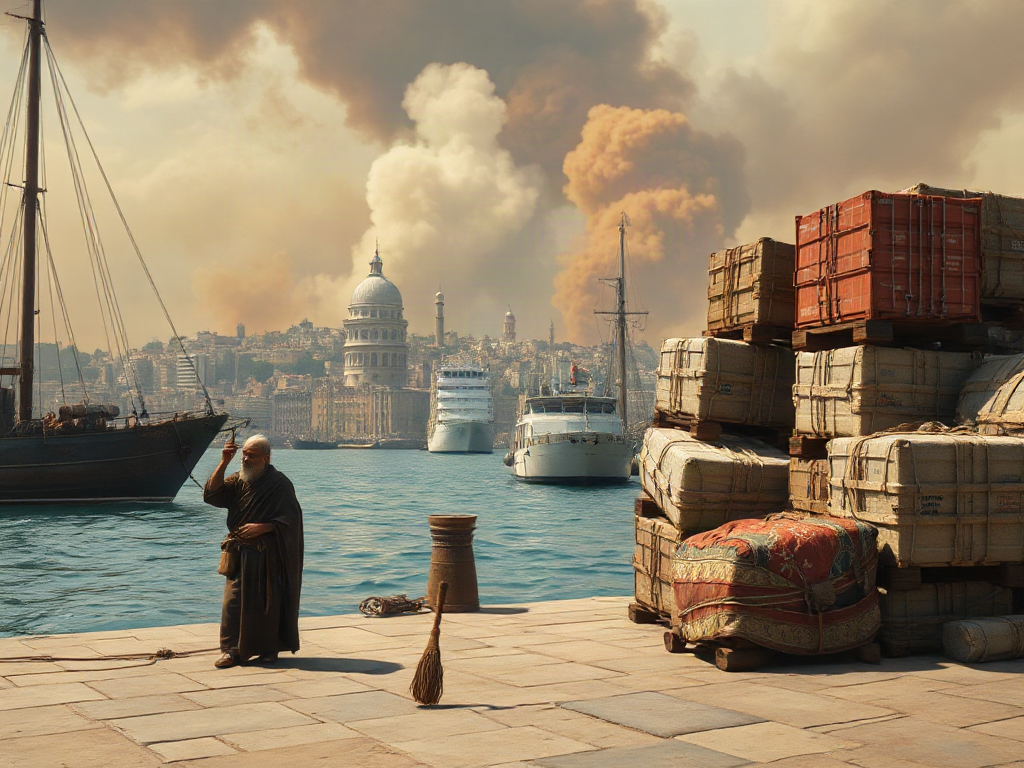
Babylon’s cargo list shows the reach of its appetite, from costly ornaments to human beings. Revelation 18:12–13 names gold, silver, precious stones, fine fabrics, fragrant goods, food, livestock, and vehicles. The accumulation makes the city’s wealth feel tangible: households and rulers have surrounded themselves with goods gathered through extensive trade.
The list reaches its darkest point when people themselves appear as merchandise. English translations handle the wording about bodies and human lives differently, but the trading context includes enslaved people. The passage exposes prosperity that can display beautiful objects while treating human lives as possessions.
Luxury alone does not explain Babylon’s guilt. The chapter also names her self-exalting confidence, deceptive influence, and responsibility for bloodshed. Reducing the warning to expensive clothes misses that larger charge. The sharper question is what a society will excuse to maintain its comfort—and whose suffering it stops seeing.
The lament also echoes Ezekiel 27, where the trading city of Tyre falls and those connected to its maritime wealth mourn. Reading those chapters together shows that John’s vision draws on an established biblical picture of proud commercial power brought low. It is not simply a coded inventory of products readers must match to today’s imports.
Babylon’s Identity and Modern Comparisons
Babylon’s identity is debated, but its defining conduct is described plainly. Revelation 17 links the woman with seven mountains and a great city exercising rule over earthly kings. Those details help explain why many interpreters see imperial Rome as an important historical reference point for the vision’s first readers.
Christian readings differ over how that reference relates to the future. Some emphasize judgment on Rome and its world. Others expect a future city or center of world power. Still others understand Babylon as a picture of oppressive civilization that appears repeatedly and faces a final judgment. These approaches can overlap, but they should not be presented as though they agree on every detail.
The name also carries the weight of earlier Scripture. Jeremiah 51 describes judgment against ancient Babylon and calls God’s people to leave her midst. Revelation reuses that prophetic language to portray a power whose wealth and apparent strength cannot shield it from accountability.
A modern resemblance is not a confirmed identification. A major port, luxury market, or powerful currency may bring the imagery to mind, but one similarity cannot settle the interpretation. Nor should the repeated reference to destruction in one hour become a precise forecast for a market crash. The wording stresses the shocking speed of Babylon’s reversal; it does not supply a usable date or countdown.
Reading the Lament Without Missing Its Warning
Revelation directs its readers away from Babylon’s sins before it describes the merchants’ tears. The call in 18:4 concerns refusing participation in her wrongdoing and avoiding a share in her judgment. Whatever view a reader holds about geography, that moral demand cannot be postponed until Babylon receives a modern name.
A useful reading sequence keeps the chapter’s voices distinct:
- Read the charges first: Note Babylon’s luxury, pride, deception, and bloodshed in verses 3–8 and 23–24.
- Identify each mourner’s loss: Compare the rulers, traders, and seafarers in verses 9–19, asking what each group valued.
- Compare earth’s grief with heaven’s response: Verse 20 celebrates God’s justice for those harmed, not the protection of Babylon’s profits.
For a family applying the passage, the question is not whether earning money is wrong. It is whether income or comfort has become a reason to excuse dishonesty, coercion, or harm. Refusing a profitable arrangement that depends on mistreating people fits the warning more closely than sharing an unverified prediction about a financial capital.
A reading remains grounded when it explains both Babylon’s appeal and the people hurt by her power. It loses its footing when every headline becomes proof, ordinary workers become targets of suspicion, or the victims disappear behind speculation about dates. The chapter asks readers to examine their loyalties, not merely identify someone else’s city.
Conclusion
The merchants’ lament becomes clearer when read beside the cargo list, Babylon’s crimes, and heaven’s response to judgment. Keep those connections ahead of attempts to match the vision to a modern economy. Read Revelation 18 alongside Ezekiel 27 and Jeremiah 51, then ask where profit might be silencing concern for other people. Christians can disagree about Babylon’s final identity without overlooking the passage’s demand to reject prosperity purchased through wrongdoing.
Frequently Asked Questions
Where does the Bible describe the merchants mourning Babylon?
The main passage is Revelation 18:11–17. The surrounding verses include the laments of kings and seafarers, while verses 1–8 explain the judgment that causes their grief.
Are the merchants the same group as the kings and sailors?
Revelation presents them as distinct groups with connected interests. Kings share Babylon’s luxury, merchants sell her goods, and seafarers depend on the shipping trade. Together, their laments show how far her influence extends.
Does Babylon’s destruction in one hour mean exactly sixty minutes?
The repeated phrase emphasizes an abrupt and devastating reversal. Readers differ over how literally to understand the timing, but the passage gives no basis for calculating a modern date or a sixty-minute economic event.
Why does heaven rejoice when Babylon falls?
Revelation 18:20 connects heaven’s joy with God’s judgment on behalf of those Babylon wronged. Revelation 19:1–3 develops that response. The focus is justice against corruption and bloodshed, not delight in ordinary families losing their livelihoods.
Must Babylon be a particular modern country or financial capital?
The text does not name a present-day nation or city. Interpretations include imperial Rome, a future center of power, and a broader pattern of corrupt civilization. Any specific modern identification goes beyond what the passage explicitly states.