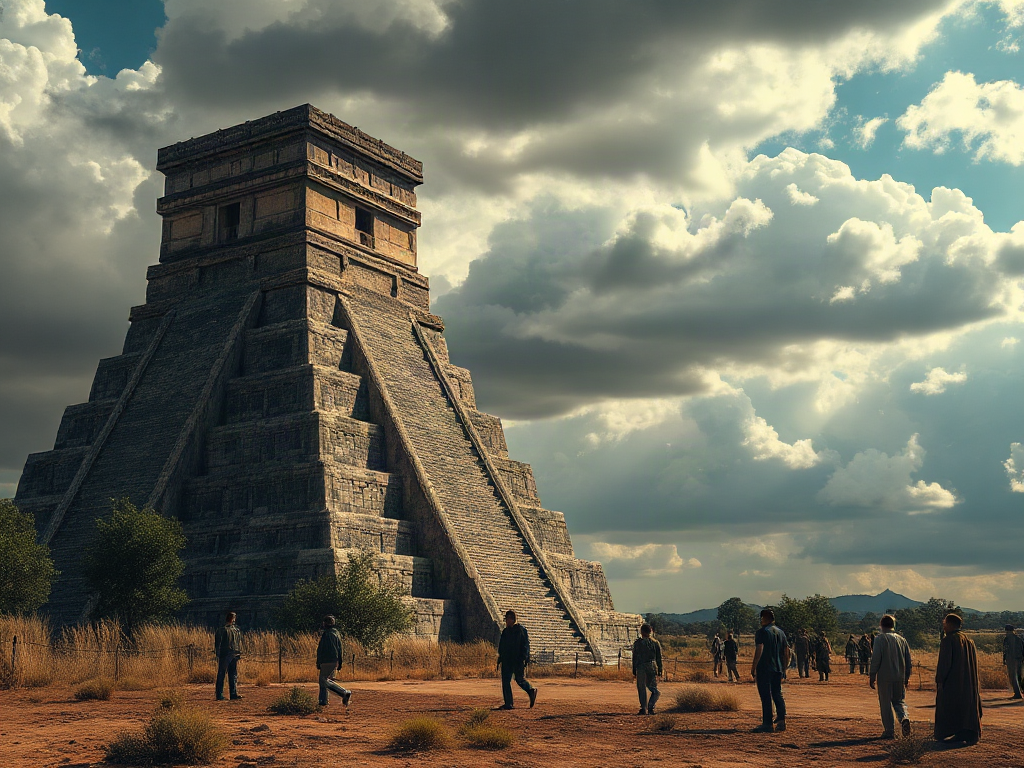
Aztec end-of-world beliefs and Scripture both describe cosmic upheaval, divine judgment, and a world changed beyond its present form, but they place those themes inside fundamentally different accounts of reality. Aztec traditions portray successive Suns, or world ages, destroyed through recurring catastrophes, with the present age vulnerable to collapse and sustained through ritual obligations. Scripture presents creation as a linear history governed by one sovereign God, culminating in final judgment, resurrection, and a new heaven and new earth. Readers should compare the underlying theology—not merely earthquakes, darkness, or fire—because similar images do not establish a shared prophecy or identical expectation.
What the Aztec Five Suns Represented
Aztec accounts placed the inhabited world within a succession of cosmic eras commonly called the Five Suns. A “Sun” in this setting was more than the object visible in the sky; it designated a world age governed by a particular cosmic order. Earlier ages ended catastrophically, and their inhabitants were destroyed or transformed. Surviving accounts vary in details and sequence, but they commonly associate the previous Suns with destructive forces such as jaguars, wind, fiery rain, and water.
The present era was known as the Sun of Movement, often connected with the sign Nahui Ollin, or Four Movement. It was expected to end through movement or earthquake. That expectation did not function exactly like a modern prediction tied to a calendar date. It belonged to a larger religious understanding in which cosmic stability was precarious, divine powers required nourishment, and human ritual activity helped preserve order. Sacrifice therefore cannot be separated from Aztec cosmology as though it were an unrelated custom. It reflected a perceived obligation to repay the gods and sustain the Sun’s motion.
A concrete expression of this concern appeared in the New Fire ceremony, held at the completion of a 52-year calendar round. Fires were extinguished, ritual observances were performed, and a new fire was kindled and distributed. The ceremony marked renewal and the continuation of cosmic order; it did not mean that Aztec society expected the world to end automatically every 52 years. Treating the ceremony as a failed countdown strips it from its ritual and calendrical setting.
Readers should also distinguish Aztec sources from later popular retellings. Much surviving information was recorded after the Spanish conquest through Indigenous pictorial traditions, Nahuatl testimony, colonial-era manuscripts, and accounts assembled under Christian rule. These sources preserve valuable material, but they may reflect regional variants, translation choices, post-conquest pressures, or attempts to organize traditions into a coherent system. A single diagram of the Five Suns should not be assumed to represent every community or every period identically.
The practical check is to ask what kind of claim a source is making. Is it describing a mythic age, a recurring ritual, a calendar structure, or a dated forecast? Confusing these categories produces sensational claims that the evidence does not support. A careful study of Aztec end-of-world beliefs compared with Scripture begins with the original cosmological role of each account rather than a modern disaster headline.
How Scripture Describes the End of the Present Age
Scripture presents history as a purposeful movement from creation toward consummation rather than an endless series of worlds repeatedly destroyed and replaced. Genesis opens with one God creating the heavens and earth, while later passages describe a definitive judgment, bodily resurrection, Christ’s reign, and the renewal of creation. Biblical writers use several images for this culmination, including the day of the Lord, resurrection, judgment before God, and the new heaven and new earth.
Different passages emphasize different dimensions. Matthew 24 records Jesus speaking about deception, persecution, conflict, cosmic signs, watchfulness, and the coming of the Son of Man. First Corinthians 15 centers on resurrection and transformation. Second Peter 3 uses the imagery of fire and calls readers to holy conduct, while Revelation 20–22 depicts final judgment, the defeat of death, and creation made new. These passages should first be read within their own literary settings instead of being blended into a single speculative chart.
The mechanism is theological: the conclusion of history occurs through God’s sovereign judgment and redemptive purpose, not because the cosmos must be continually fed by human offerings. Scripture treats sacrifice very differently from Aztec ritual obligation. In Christian interpretation, Christ’s self-offering is decisive and unrepeatable; human beings do not preserve the universe by supplying divine nourishment. Faithfulness, repentance, endurance, and readiness are responses to God, not techniques for preventing cosmic failure.
Interpretive disagreements remain among Christians. Premillennial, amillennial, and postmillennial readings differ over the millennium in Revelation 20, while views of tribulation and the timing of Christ’s return also vary. Those disagreements affect proposed sequences, but they do not turn biblical history into the Aztec succession of Suns. The shared Christian center is that creation has a Creator, judgment is morally accountable, resurrection concerns human destiny, and renewal comes through God’s action.
A common mistake is to isolate a vivid symbol—fire, darkness, earthquake, or a falling star—and declare it equivalent to an image in another religion. Similar catastrophe language may arise because societies experience storms, drought, eclipses, earthquakes, warfare, and death. The better test asks who acts, why judgment occurs, whether history repeats, what happens to the dead, and what hope follows. Those questions reveal the structure of the biblical message more accurately than matching dramatic vocabulary.
Where the Two Traditions Resemble—and Contradict—Each Other
The clearest resemblance is that neither tradition treats the present world order as permanent. Both contain catastrophic imagery and connect cosmic disruption with divine realities. Earth movement has a special place in accounts of the current Aztec Sun, while earthquakes and disturbances in the heavens appear in several biblical passages. Both traditions could also shape communal conduct by placing ordinary life within a larger sacred order.
Those similarities are limited, however, because the accounts answer basic questions differently. Aztec cosmology describes multiple world ages and a universe whose continuation was bound to reciprocal duties involving gods and humans. Scripture describes one created order moving toward a final reckoning under one God. The Aztec pattern is successive and vulnerable; the scriptural pattern is linear and directed toward resurrection and enduring renewal.
The identity of the divine is an even greater divide. Aztec religion involved multiple deities with distinct associations, rivalries, gifts, and ritual claims. The Bible’s end-of-age teaching rests on exclusive monotheism: the Creator is not one power within a larger unstable cosmos. This difference changes the meaning of sacrifice. Aztec offerings participated in cosmic reciprocity, whereas the New Testament grounds reconciliation in Christ and rejects the premise that repeated human bloodshed must keep creation functioning.
The final human outcome also differs. Transformation or destruction of inhabitants in former Suns is not equivalent to the biblical doctrine of resurrection. Scripture presents the dead as raised and judged, with death itself ultimately defeated. Revelation’s new Jerusalem is not simply another temporary age awaiting the same collapse; it portrays God dwelling with his people, mourning ended, and the curse removed. Calling both traditions “cycles of death and rebirth” therefore misstates the Christian claim and oversimplifies the Aztec material.
Consider a reader who sees an online graphic pairing the Aztec Sun of Movement with Jesus’ reference to earthquakes. The image may look persuasive because one visual feature appears on both sides. Yet the comparison fails if it ignores ritual maintenance, the sequence of Suns, monotheism, resurrection, and final renewal. Parallel imagery establishes a subject for investigation, not dependence, fulfillment, or agreement.
A useful comparison can be reduced to four questions:
- Time: Are world ages recurring, or does history reach one appointed culmination?
- Agency: Is cosmic order sustained through reciprocal offerings, or completed by the sovereign Creator?
- Judgment: Is catastrophe chiefly cosmic replacement, or a moral judgment involving resurrection?
- Hope: Does another vulnerable age begin, or are death and disorder finally overcome?
These distinctions keep Aztec end-of-world beliefs compared with Scripture from collapsing into either superficial similarity or dismissive caricature.
A Reliable Method for Comparing Aztec Beliefs With Scripture
Sound comparison starts with primary context before moving to theological conclusions. For Aztec material, identify the manuscript, monument, colonial account, or modern scholarly interpretation behind a claim. For Scripture, identify the book, passage, genre, speaker, and immediate argument. A museum description of the Calendar Stone and a social-media claim about an exact doomsday date do not carry equal evidentiary weight; neither does an isolated verse outweigh its surrounding chapter.
Next, separate description from interpretation. A source may reliably report that a symbol represents movement without proving every proposed theory about how Aztec communities expected the age to end. Likewise, a biblical passage may plainly announce judgment while leaving Christians divided about the chronology of related events. Marking what the source directly says, what scholars infer, and what remains disputed prevents confidence from outrunning evidence.
Use this compact checking process when encountering a proposed parallel:
- Locate the source. Find the actual Aztec or colonial evidence and the complete scriptural passage.
- Define the key terms. Determine whether “Sun,” “world,” “fire,” or “renewal” has the same function in both settings.
- Compare the worldview. Examine divine identity, human obligation, time, judgment, death, and the expected future.
- Test the claimed connection. Ask whether the evidence shows resemblance, historical borrowing, contradiction, or merely a shared human image.
- State the limit. Acknowledge variant Aztec accounts and disputed Christian chronology rather than forcing certainty.
This method works especially well for claims that the Aztecs predicted a specific modern disaster or that their Five Suns secretly reproduce biblical prophecy. Signs that an argument is failing include no named source, an English phrase presented as though it were a literal ancient quotation, merged Maya and Aztec calendars, or a conclusion based entirely on one matching symbol. A stronger argument cites the source tradition, preserves uncertainty, and compares whole belief structures.
Respectful comparison does not require treating incompatible claims as interchangeable. A Christian reader can acknowledge the sophistication of Aztec calendrics and the seriousness of Aztec cosmic thought while still concluding that its theology conflicts with Scripture. Conversely, historical study should not rewrite Aztec religion as an incomplete version of Christianity. Each account deserves to be represented in its own categories before evaluation begins.
The most productive next step is to read Genesis 1–3, Matthew 24, 1 Corinthians 15, 2 Peter 3, and Revelation 20–22 alongside a museum or academic treatment of the Five Suns and the New Fire ceremony. Keep separate notes for textual claims, scholarly reconstruction, and theological assessment. That practice makes the comparison transparent and exposes unsupported leaps before they become conclusions.
Frequently Asked Questions
Did the Aztecs believe the world had already ended four times?
Aztec traditions described four earlier Suns, or world ages, ending in catastrophes before the present Sun. The surviving versions differ in some details, so the scheme should be treated as a cosmological tradition rather than a modern historical record.
Did the Aztecs predict a specific date for the end of the world?
The present Sun was associated with an eventual end through movement or earthquake, but that is not the same as a securely documented prediction for a particular modern date. Claims of exact countdowns require a named primary source.
Is the Aztec Five Suns story similar to Revelation?
Both contain cosmic catastrophe, but their structures differ. The Five Suns belong to successive ages sustained within Aztec ritual cosmology; Revelation moves toward final judgment, resurrection, and permanent renewal under one Creator.
Does shared earthquake imagery prove a connection?
No. Earthquakes are widely experienced natural events and appear in many religious traditions. Evidence of borrowing or fulfillment would require stronger historical and textual links than a shared image.
What Bible passages are most useful for this comparison?
Genesis 1–3, Matthew 24, 1 Corinthians 15, 2 Peter 3, and Revelation 20–22 clarify creation, judgment, resurrection, cosmic upheaval, and renewal. Reading complete sections prevents isolated symbols from controlling the comparison.
Further Reading
Authoritative Sources
- Aztec Religion
britannica.comProvides a concise reference account of Aztec deities, ritual obligations, sacrifice, and cosmology
- The Aztec World
metmuseum.orgPlaces Aztec religion and material culture within the historical setting of central Mexico
- 2 Peter 3
biblegateway.comSupplies the full scriptural context for judgment by fire, divine timing, and the promised new creation
- Revelation 20–22
biblegateway.comPresents final judgment, the defeat of death, and the new heaven and new earth in their literary sequence
Conclusion
The decisive issue is not whether both traditions mention catastrophe, but what their images mean within their respective accounts of gods, humanity, time, sacrifice, and hope. The Five Suns express successive cosmic orders, ritual reciprocity, and the vulnerability of the present age. Scripture moves from creation toward an appointed judgment, bodily resurrection, and a renewed creation secured by God rather than maintained through human offerings.
Readers should verify Aztec claims against identifiable historical or museum sources, read biblical passages in context, and label disputed interpretations honestly. Begin with the worldview-level questions—divine identity, historical direction, moral judgment, and final human destiny—before comparing individual symbols. That order preserves genuine parallels without turning resemblance into proof of equivalence, borrowing, or fulfilled prophecy.