Creatures appearing in end-time biblical imagery include the dragon, two beasts, the Lamb, four living creatures, apocalyptic horses, locust-like attackers, frog-like spirits, and birds gathered for judgment. Revelation uses these figures to portray Satan, oppressive political authority, deceptive religious power, divine sovereignty, warfare, demonic activity, and the consequences of rebellion. Readers should identify each creature from its immediate passage, trace explicit explanations within the book, and then compare related texts in Daniel, Ezekiel, Zechariah, and the Gospels. Treating every physical feature as a coded modern prediction usually obscures the imagery’s scriptural background and theological purpose.
Why Revelation Uses Creatures as Symbols
Animal imagery gives visible form to powers, loyalties, judgments, and spiritual realities that cannot be represented adequately by ordinary description. Revelation belongs to the apocalyptic tradition, a form of writing rich in visions, symbolic numbers, heavenly scenes, composite beings, and dramatic contrasts. Its creatures are not decorative additions. Their identities, actions, and relationships help communicate who holds authority, who imitates authority, and where competing allegiances lead.
Much of this visual language comes from earlier Scripture. Daniel sees beasts emerging from the sea and is told that they represent kings or kingdoms. Ezekiel encounters four living beings around the divine throne. Zechariah sees colored horses sent through the earth. Revelation draws these strands together while placing Jesus Christ, portrayed prominently as the slain yet victorious Lamb, at the center of the vision. Recognizing those connections is more reliable than beginning with modern headlines or speculative creature identifications.
The narrative setting also matters. A creature near God’s throne does not perform the same literary role as a monster rising from the sea or an army released from the abyss. Location, speech, worship, authority, and opposition all help establish meaning. The dragon seeks to destroy and deceive; the Lamb receives worship and opens the sealed scroll; the living creatures lead heavenly praise. Those actions are often more interpretively decisive than horns, wings, colors, or other individual details.
A common mistake is to assume that symbolism makes the text unreal. Biblical symbols can describe realities regarded by the author as intensely consequential, including persecution, empire, idolatry, war, and divine judgment. Symbolic does not mean trivial or imaginary. At the same time, imagery should not automatically be converted into a literal zoological forecast. The better question is not, “What modern animal or machine looks like this?” but, “What does the passage say this figure does, and what earlier scriptural language does it reuse?”
Readers examining Creatures Appearing in End-Time Biblical Imagery should therefore distinguish among divine attendants, messianic figures, agents of judgment, hostile empires, and demonic powers. That basic classification prevents unlike creatures from being forced into a single interpretive category.
The Dragon and the Two Beasts
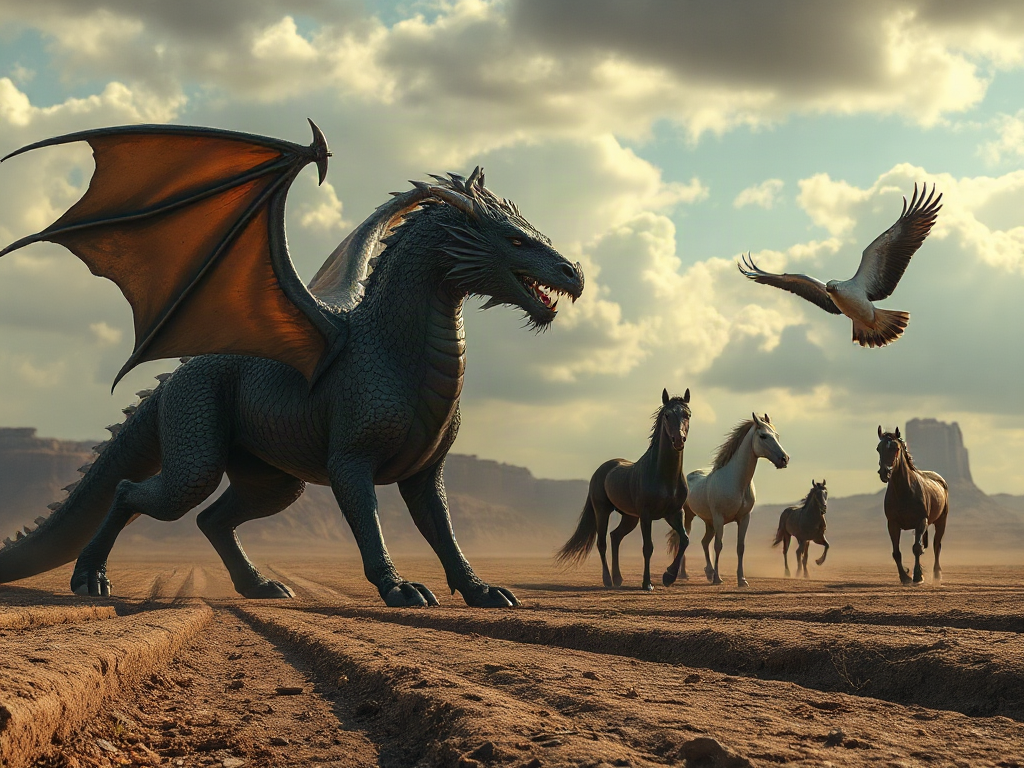
The dragon and the two beasts form Revelation’s clearest cluster of hostile creature imagery. Revelation 12 identifies the great red dragon as the ancient serpent called the Devil and Satan. That direct explanation should control interpretation. Its heads, horns, crowns, sweeping tail, and pursuit of the woman and her offspring portray enormous power, political reach, violence, and opposition to God’s purposes rather than an unidentified biological animal.
Revelation 13 then presents a beast rising from the sea. Its blended features recall the lion, bear, leopard, horns, and kingdoms of Daniel 7. The sea beast receives authority from the dragon, demands allegiance, speaks arrogantly, and wages war against the saints. These actions associate it with coercive ruling power organized in rebellion against God. Many interpreters connect its first-century expression with Roman imperial authority, while differing over whether the image also anticipates a final ruler, recurring empire-like systems, or both.
A second beast rises from the earth. It resembles a lamb but speaks like a dragon, performs signs, directs worship toward the first beast, and enforces the beast’s mark. Revelation later calls this figure the false prophet. Its lamb-like appearance suggests counterfeit innocence or borrowed religious legitimacy, while its speech exposes its true allegiance. The contrast warns that deception may look pious before it becomes coercive.
The three figures work together as a parody of divine rule: the dragon grants authority, the sea beast exercises it, and the earth beast promotes worship through deception. Readers sometimes isolate the number 666 or the mark from this larger structure. That approach misses the central issue of worship and loyalty. Buying and selling restrictions matter in the narrative because economic pressure becomes a means of compelling allegiance, not because commerce is the passage’s only concern.
Interpretations differ sharply over how precisely these symbols map onto past and future events. A historically grounded reading asks what the imagery communicated to churches living under Roman power. A futurist reading emphasizes a culminating end-time manifestation. An idealist reading sees a recurring pattern of satanic, political, and religious opposition. These approaches need not erase the text’s stable claims: Satanic deception animates anti-God authority, counterfeit worship supports it, and faithful witness carries a real cost.
The practical test is whether an interpretation follows the passage’s explicit identifications and Danielic background. A proposal is weakening when it depends mainly on visual resemblance to a current politician, institution, logo, or technology. Such matches change rapidly and often ignore the creatures’ stated functions.
The Lamb and the Four Living Creatures
The Lamb is Revelation’s controlling creature image for Jesus Christ. He appears as slain yet standing, combining sacrificial death with resurrection and victory. In Revelation 5, the apparent Lion of Judah is seen as a Lamb who has been slaughtered. That deliberate shift redefines conquest: the Messiah triumphs through faithful self-giving, receives universal worship, and alone is worthy to open the scroll.
The Lamb’s horns and eyes communicate complete power and searching knowledge within the symbolism of the vision. His blood redeems a people from every tribe, language, people, and nation. Later scenes place the Lamb in opposition to the beast, alongside the sealed faithful, and at the center of the marriage supper. Interpreting the Lamb merely as a gentle animal misses the paradox. He is sacrificial, royal, judicial, and victorious at once.
The four living creatures around God’s throne serve a different purpose. Revelation 4 describes forms resembling a lion, ox, human, and flying eagle, with wings and eyes. Their closest background is Ezekiel’s throne vision, supplemented by imagery resembling Isaiah’s seraphim. They continually proclaim God’s holiness and participate in heavenly worship and the opening of the first four seals. The text does not identify them as four human evangelists, four modern nations, or four phases of history.
Some Christian traditions have associated the four faces with the four Gospel writers. That symbolism has a long history in art and theology, but it should be distinguished from what Revelation itself states. Within the vision, the creatures are heavenly attendants whose appearance evokes the animate creation around the Creator’s throne. Their many eyes suggest wakefulness or comprehensive awareness, while their unceasing praise establishes worship as the proper response to divine sovereignty.
The Lamb and the living creatures also expose a frequent interpretive imbalance. Readers may devote extensive attention to monsters while overlooking the throne room that frames their activity. Revelation does not present evil as an equal rival to God. The beasts exercise permitted and limited authority; the Lamb possesses rightful rule and final victory. That hierarchy is a central constraint on any reading of Creatures Appearing in End-Time Biblical Imagery.
A sound reading therefore asks who receives worship and who redirects it. The Lamb receives worship because of his identity and redemptive work. The false prophet redirects worship toward the beast. The living creatures orient attention toward God. Following that worship pattern reveals the book’s moral divisions more clearly than attempting to decode every anatomical feature separately.
Horses, Locusts, Frogs, and Birds
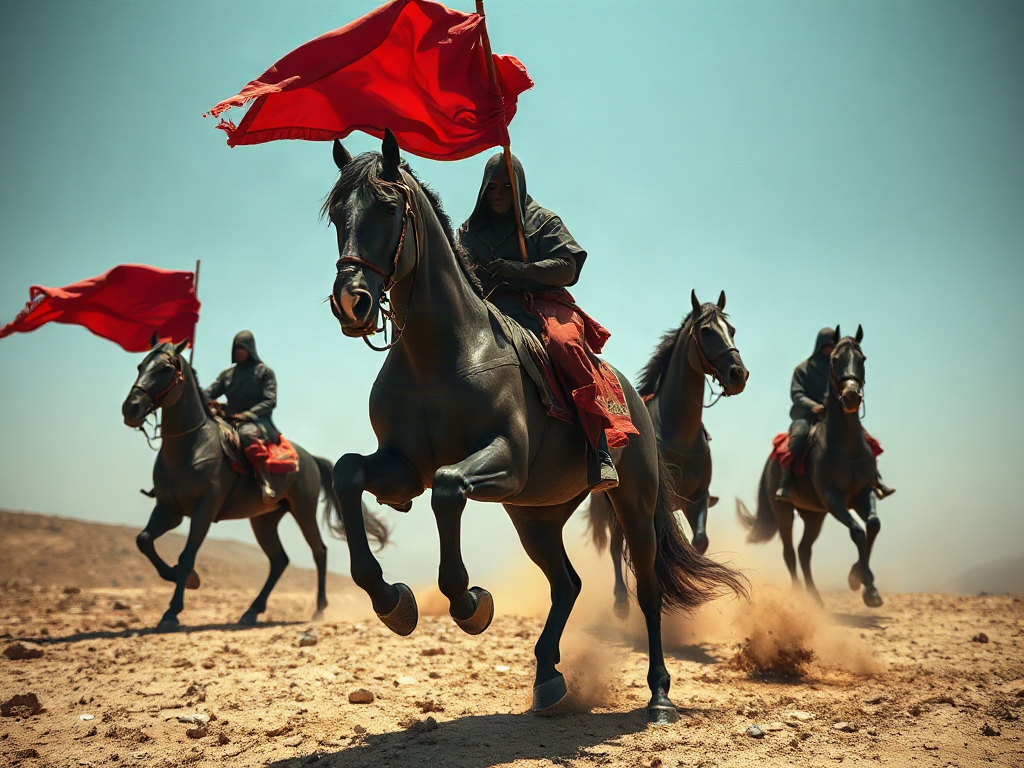
Revelation’s other creatures often function as agents or signs of judgment rather than as individual rulers. The four horses of Revelation 6 appear as the Lamb opens the first four seals. Their riders bring conquest, warfare, scarcity, and death. The sequence draws from Zechariah’s colored horses but adapts the imagery to show cascading devastation. The horses should be read together because each calamity intensifies the effects of the others: conquest produces conflict, conflict disrupts food, and scarcity contributes to death.
The locust-like beings released from the abyss in Revelation 9 are more grotesque. They combine features of horses, humans, lions, scorpions, and armored troops. Their king is the angel of the abyss, named Abaddon in Hebrew and Apollyon in Greek. Unlike ordinary locusts, they are forbidden to damage vegetation and instead torment people lacking God’s seal. Those instructions rule out a straightforward description of a natural swarm.
Modern readings have sometimes identified the locusts as helicopters or another military technology because of isolated visual similarities. That comparison may feel vivid, but it overlooks the passage’s composite symbolism, supernatural setting, moral restrictions, and links to the plague tradition. The vision evokes invasion, demonic oppression, and terror. Pinning it to one machine usually creates more problems than it solves.
Revelation 16 describes three unclean spirits like frogs emerging from the mouths of the dragon, beast, and false prophet. They deceive rulers and gather them for battle. The frog-like form may recall Egypt’s plagues and reinforces uncleanness, but their origin from the mouth emphasizes deceptive communication. Their role is not to attack physically; it is to mobilize through signs and false persuasion.
Birds appear in a grimly different scene. In Revelation 19, an angel summons birds to feast on the defeated forces opposing the returning Christ. This image echoes Ezekiel 39 and reverses the honor of a celebratory banquet: the rebels who expected victory become food for scavengers. The point is judicial humiliation and the completeness of defeat, not an independent prophecy about bird behavior.
These examples support a useful classification:
- Horses: escalating historical and social calamities under the seals.
- Locust-like beings: restricted torment associated with the abyss.
- Frog-like spirits: deceptive powers gathering rulers for conflict.
- Birds: witnesses and participants in the aftermath of judgment.
The classification is working when each interpretation accounts for the creature’s source, instructions, actions, and narrative outcome. It is failing when one visual resemblance overrides all four.
A Careful Method for Interpreting the Creatures
A disciplined interpretation begins inside the passage before moving to a news report, theological system, or proposed timeline. Revelation sometimes explains its own imagery: the dragon is Satan, the waters represent peoples, and certain heads and horns signify rulers or kingdoms. Explicit explanations deserve greater weight than conjecture based on shape, color, or number.
Next, trace the Old Testament source. Daniel is indispensable for beasts and horns; Ezekiel illuminates living creatures, divine chariots, and the birds summoned after battle; Zechariah supplies important horse imagery; Exodus informs plague language; and Genesis stands behind the ancient serpent. Shared vocabulary does not make every pair of passages identical, but it establishes the symbolic world in which Revelation communicates.
A compact checking method keeps the process accountable:
- Read the full vision unit. Do not separate a creature from the scene before and after it.
- Record explicit identifications. Note what the narrator or angel actually explains.
- Compare earlier scriptural imagery. Prioritize close verbal and thematic parallels.
- Identify the creature’s function. Ask whether it worships, deceives, rules, judges, torments, or bears witness.
- Test proposed applications. Reject claims that require details absent from the text or collapse after a headline changes.
Historical context and future expectation should be handled without forcing an unnecessary choice at every point. Revelation addressed actual first-century congregations facing pressure, compromise, and imperial claims. Its patterns may also have broader or future significance. A responsible interpretation shows how the original audience could understand the warning before asserting a specific fulfillment unknown to them.
Genre provides another constraint. Apocalyptic images regularly combine features that cannot exist together in ordinary anatomy. That signals theological communication through vision, not a demand to draw a literal field guide. Conversely, calling everything symbolic does not permit arbitrary meanings. Symbols are bounded by textual explanations, scriptural precedents, and narrative function.
Readers should be especially cautious with interpretations built around a single current leader, weapon, organization, or digital system. A credible proposal should explain the entire symbolic profile and its biblical background, not merely one striking feature. It should also acknowledge where interpreters disagree. Examining Creatures Appearing in End-Time Biblical Imagery is most fruitful when the goal is to understand Revelation’s claims about worship, endurance, deception, judgment, and Christ’s authority rather than to produce a fragile prediction calendar.
Frequently Asked Questions
Are the creatures in Revelation meant to be literal animals?
Most are visionary symbols whose meanings come from their actions, textual explanations, and earlier biblical imagery. Symbolic language can still refer to real rulers, conflicts, spiritual powers, and judgments.
What does the dragon represent in Revelation?
Revelation 12 explicitly identifies the dragon as the ancient serpent, the Devil, and Satan. Its conflict with the woman and her offspring depicts satanic opposition to God’s Messiah and faithful people.
Are the sea beast and earth beast the same figure?
No. The sea beast exercises coercive authority received from the dragon, while the earth beast promotes worship of the first beast through signs and deception. The latter is later called the false prophet.
Do Revelation’s locusts represent military helicopters?
The passage does not identify them as helicopters. Their origin in the abyss, composite bodies, unusual restrictions, and supernatural ruler make demonic judgment imagery a stronger textual explanation than a match to one modern weapon.
Which earlier biblical books best explain Revelation’s creatures?
Daniel, Ezekiel, Zechariah, Exodus, Genesis, and Isaiah provide major backgrounds. Comparing those passages helps readers recognize inherited symbols without assigning meanings from visual resemblance alone.
Conclusion
Revelation’s creatures become clearer when readers prioritize identification, scriptural background, narrative role, and worship allegiance. The dragon and beasts expose satanic deception and coercive power; the Lamb embodies sacrificial victory and rightful rule; heavenly living creatures affirm God’s sovereignty; and horses, locusts, frogs, and birds portray distinct dimensions of judgment.
The next step is to read each vision as a complete unit, mark every explanation supplied by the text, and compare its language with Daniel, Ezekiel, Zechariah, and other cited backgrounds. Interpretations should be reconsidered when they rest on one modern resemblance, ignore the original congregations, or make evil appear equal to divine authority. Careful reading will not remove every disagreement about chronology, but it does keep attention on Revelation’s durable concerns: faithful witness, resistance to counterfeit worship, discernment under pressure, and confidence in the Lamb’s final victory.