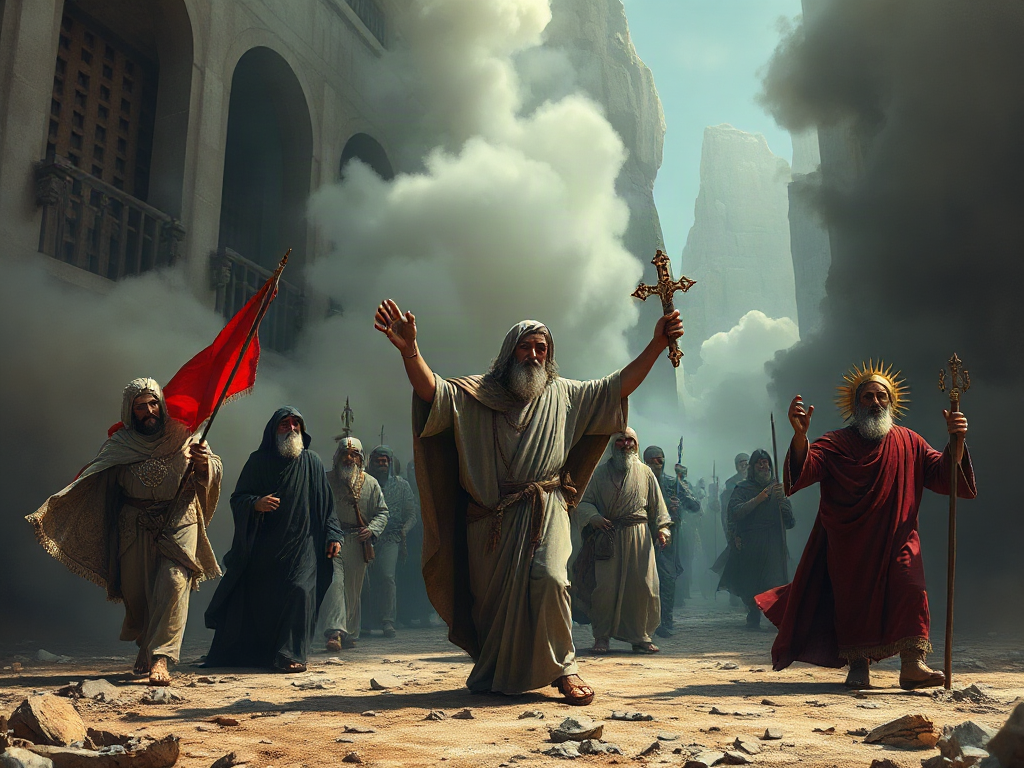

Jesus used Noah’s days as an end-times comparison to emphasize sudden judgment, ordinary life continuing before the crisis, widespread unpreparedness, and the need for sustained watchfulness. In Matthew 24 and Luke 17, people were eating, drinking, marrying, buying, selling, planting, and building until judgment arrived. The comparison primarily concerns unexpected timing and divided outcomes rather than proving that every condition before the Flood must reappear. Readers should interpret the analogy within each Gospel passage, avoid speculative date-setting, and treat readiness as faithful daily conduct rather than panic driven by headlines.
Where Jesus Compared His Return to Noah’s Days
The comparison appears most directly in Matthew 24:36–44 and Luke 17:26–30. Matthew places it within Jesus’ teaching about the coming of the Son of Man: no one knows the day and hour, people continue ordinary activities, and the Flood arrives before the unprepared recognize their danger. Luke pairs Noah with Lot, creating a second example of daily routines continuing until abrupt judgment changes everything.
Genesis 6–9 supplies the narrative behind Jesus’ words. Genesis describes human corruption and violence, God’s announced judgment, Noah’s obedience, the ark, the Flood, and the preservation of Noah’s household. Jesus did not retell every feature of that account. He selected recognizable details that served His immediate warning. That distinction controls responsible interpretation: the source narrative is broad, but the Gospel analogy has a focused purpose.
Matthew emphasizes ignorance of the approaching Flood and the inability to calculate the timing of the Son of Man’s coming. Luke emphasizes ordinary economic and domestic activity immediately before destruction. Eating, marrying, planting, and building are not condemned as inherently sinful. Their rhetorical force comes from normality. People organized life around familiar expectations while remaining unresponsive to divine warning.
A common mistake is to import every element of Genesis into Jesus’ comparison. Some readings assume that the final period must duplicate every social condition, demographic detail, or unusual feature associated with Genesis 6. An analogy does not require total correspondence. If Jesus explicitly highlights timing, routine, surprise, and separation, those features deserve priority over details He does not mention.
Readers comparing the passages should begin with three checks: identify the details Jesus names, observe the command attached to the analogy, and distinguish those points from later speculation. In Matthew, the practical command is to stay awake and be ready. In Luke, the warning is reinforced by the fate of Lot’s wife and the danger of clinging to one’s present life. This passage-first method keeps Noah’s days as an end-times comparison anchored to Jesus’ stated purpose.
What the Comparison Says About Timing
Jesus’ timing emphasis is uncertainty for human observers, not uncertainty about whether God will act. Matthew moves from the unknown day and hour to Noah’s generation, then to a householder who does not know when a thief will come. The repeated logic is clear: an event can be certain while its date remains unavailable to those awaiting it.
The people before the Flood knew normal schedules—meals, weddings, work, and household plans—but failed to reckon with the approaching interruption. Their error was not merely lack of calendar information. They lived as though ordinary continuity settled the future. Jesus challenges that assumption by presenting decisive judgment as something that can arrive while life appears stable enough for long-term planning.
This rules out two opposite errors. Date-setting claims more chronological knowledge than the passage grants. Indifference assumes that an unknown date removes urgency. Jesus supports neither approach. Watchfulness means living faithfully without possessing a countdown. A person does not need to suspend work, marriage, farming, construction, or prudent planning; Luke names such activities precisely because routine life may continue until the turning point.
Consider two responses to a confident prediction about a prophetic date. One person reorganizes life around the prediction, abandons ordinary responsibilities, and treats disagreement as spiritual blindness. Another dismisses every warning because earlier predictions failed. Both reactions miss Jesus’ instruction. The first replaces watchfulness with calculation; the second replaces watchfulness with complacency. The better response tests the claim against Scripture, refuses dates the text does not disclose, and examines whether present conduct is faithful.
A useful interpretation checklist is compact:
- Check the text: Does the claim arise from words in the passage or from added assumptions?
- Check the timing claim: Does it respect Jesus’ statement that the day and hour are unknown?
- Check the result: Does it encourage steady obedience or produce panic, neglect, and fixation?
- Check the scale: Is a current event being treated as possible context or declared conclusive proof?
The comparison therefore supports readiness across an indefinite waiting period. A reading is failing when it depends on ever-changing calculations, must be revised after missed deadlines, or draws more attention to an interpreter’s timetable than to Jesus’ command.
Which Features of Noah’s World Matter Most
Four features carry the greatest interpretive weight: moral accountability, ordinary routines, ignored warning, and a sudden division between outcomes. Genesis provides the moral setting, while Matthew and Luke specify how Jesus applies the history. Holding those layers together prevents the comparison from shrinking into either a vague moral lesson or a detailed code for decoding current events.
Corruption and Accountability
Genesis 6 portrays a world marked by pervasive wickedness and violence. That background matters because the Flood is presented as judgment, not an unexplained natural disaster. Yet Jesus’ Gospel comparison does not provide a scale for measuring when modern society has become wicked enough to trigger the end. Attempts to rank generations or identify a precise moral threshold go beyond the text.
The practical use is personal and communal examination. Violence, exploitation, deceit, and hardened disregard for God fit the Genesis setting more directly than broad claims that every disliked cultural change fulfills Noah’s world. Specific moral analysis is more responsible than treating “the days of Noah” as a label for everything troubling in society.
Normal Life and Unrecognized Danger
Matthew and Luke place unusual weight on recognizable activities. Weddings, meals, commerce, agriculture, and construction suggest confidence that tomorrow will resemble today. The problem is not planning itself but a closed horizon in which judgment, accountability, and God’s claim on life have no practical place.
For example, a community may remain economically active and socially celebratory while tolerating deep injustice. Visible normality does not settle its moral condition. Conversely, a period of war, disaster, or economic disruption does not automatically prove that the final moment has arrived. Jesus’ analogy warns against being spiritually anesthetized by routine, not against ordinary work.
Separation and Deliverance
Noah’s household passes through judgment because Noah responds to God’s instruction. The New Testament later uses Noah and the ark in theological discussions of faith, salvation, baptism, and judgment, including Hebrews 11:7 and 1 Peter 3:18–22. Those passages can deepen study, but their distinct arguments should not be collapsed into Matthew 24.
Another interpretive dispute concerns the people “taken” and “left” in Matthew 24. Because the Flood took away the unprepared, some readers understand “taken” negatively; others connect it with gathering or rescue. The immediate context deserves careful study before building a detailed sequence on two verbs. The central point remains secure despite that debate: the coming event produces a decisive separation, so present readiness cannot be borrowed from family, culture, or religious association.
How to Apply the Warning Without Speculation
Responsible application begins with the commands Jesus actually gives: stay awake, remain ready, and do not let ordinary life erase accountability. These are durable obligations rather than emergency measures activated by a particular headline. They concern character, allegiance, stewardship, and perseverance over time.
Start by reading Matthew 24:36–44 and Luke 17:26–37 in full rather than isolating the phrase “days of Noah.” Note repeated words, examples, commands, and changes of subject. Then read Genesis 6–9 to recover the original narrative. This order prevents a familiar phrase from accumulating meanings detached from its biblical settings.
Next, separate observation from conclusion. A reader may observe violence, public indifference, or confidence in normal life. Those observations can make Noah’s account morally relevant, but they do not establish a prophetic date. The stronger conclusion is that such conditions expose recurring human tendencies already addressed by Scripture. The weaker conclusion is that one news cycle proves a precise position on an end-times calendar.
Readiness can then be tested through concrete questions. Are unresolved wrongdoing and damaged relationships being addressed rather than postponed? Are work, money, and household obligations being handled honestly? Does prophetic study produce patience, holiness, courage, and care for others, or suspicion, obsession, and neglect? A sound application should make conduct more faithful even if the expected timeline proves mistaken.
Community also provides a safeguard. Claims about hidden timelines, exclusive revelations, or mandatory reactions should be examined with mature believers and against the full scriptural context. Interpretive traditions differ over the sequence of future events, but none needs to override Jesus’ explicit refusal to supply the day and hour. Humility is not indecision; it is recognition of what the passage reveals and what it withholds.
The link between watchfulness and ordinary duty is especially important. Noah’s obedience involved sustained, concrete action rather than momentary alarm. Modern readers should not imitate the ark’s construction literally or assume that physical stockpiling fulfills Jesus’ command. Sensible preparation for ordinary emergencies may be prudent, but it is not a substitute for repentance, faithfulness, and ethical responsibility. A useful treatment of Noah’s days as an end-times comparison should leave readers steadier, not more vulnerable to sensational claims.
Frequently Asked Questions
What did Jesus mean by “the days of Noah”?
He highlighted people continuing normal life without recognizing approaching judgment. The comparison calls for readiness because the Son of Man’s coming will not conform to a publicly known timetable.
Was Jesus comparing the end times to the violence of Genesis 6?
Genesis establishes a background of corruption and violence, but Matthew and Luke explicitly emphasize routine activity, unawareness, sudden judgment, and divided outcomes. Violence is relevant context, not the only or clearest point of Jesus’ analogy.
Do the days of Noah identify a specific modern generation?
The passages do not name a modern generation or provide a formula for identifying one. Applying them to current conduct is warranted; claiming they establish a date or exact generation requires assumptions beyond the text.
Are eating, marrying, buying, and building presented as sins?
No. They are ordinary activities. Jesus uses them to show how normal life may continue while people remain inattentive to divine accountability and an approaching interruption.
What does readiness look like in practical terms?
Readiness includes faithful conduct, repentance, honest stewardship, attention to Jesus’ teaching, and refusal to base belief on speculative dates. It should strengthen daily responsibility rather than encourage panic or withdrawal.
Further Reading
Authoritative Sources
- Matthew 24:36–44
biblegateway.comRead Jesus’ direct comparison between Noah’s generation and the coming of the Son of Man
- Luke 17:26–37
biblegateway.comCompare Luke’s parallel teaching, including the examples of both Noah and Lot
- Genesis 6–9
biblegateway.comExamine the Flood narrative that supplies the historical and theological background for Jesus’ analogy
- 1 Peter 3:18–22
biblegateway.comSee how another New Testament passage uses Noah’s preservation within a distinct theological argument
Conclusion
Noah’s account should direct attention toward Jesus’ warning rather than become raw material for elaborate timetables. Matthew and Luke emphasize ordinary life continuing, judgment arriving without a disclosed date, and a decisive separation that exposes whether people were prepared. Genesis adds the moral setting of corruption, violence, accountability, and Noah’s obedient response.
The sound next step is textual before it is speculative: read the Gospel passages in context, compare them with Genesis 6–9, and mark what Jesus states explicitly. Test modern claims by whether they honor the unknown timing and produce faithful conduct. Prophetic interpretation is serving its purpose when it encourages repentance, endurance, responsible daily life, and sober hope—not when it depends on deadlines, fear, or forced parallels with every disturbing event.