
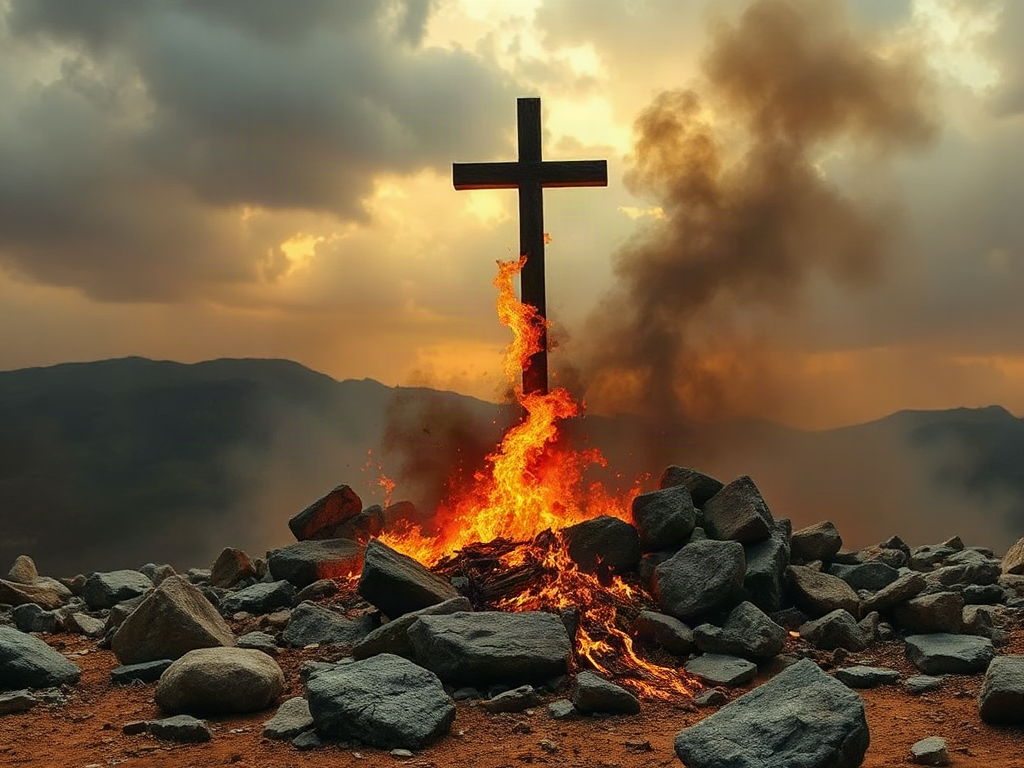
The second death in biblical end-times passages is Revelation’s name for the final judgment associated with the lake of fire, following resurrection and the judgment before the great white throne. Revelation mentions it four times, contrasting the fate of the condemned with the security of faithful believers and those who share in the first resurrection. Death and Hades are themselves cast into the lake of fire, showing that the judgment belongs to the final defeat of death and evil. Christians differ over whether this punishment means eternal conscious suffering, irreversible destruction, or another final outcome, but the text consistently presents it as decisive and warns against confusing it with ordinary physical death.
What you’ll learn
This guide covers the following practical points:
- Where Revelation Names the Second Death — Revelation uses “the second death” in four places: Revelation 2:11, 20:6, 20:14, and 21:8.
- How the Second Death Fits Revelation’s Judgment Sequence — The second death appears near the end of Revelation’s conflict between God’s kingdom and rebellious powers.
- What the Lake of Fire Language Communicates — The lake of fire functions as Revelation’s climactic image of divine judgment and exclusion from the new creation.
- How to Evaluate the Main Interpretations — Christian interpreters agree more readily on the second death’s seriousness and final setting than on the precise nature of the punishment.
Where Revelation Names the Second Death
Revelation uses “the second death” in four places: Revelation 2:11, 20:6, 20:14, and 21:8. Reading all four together supplies a more reliable definition than building a doctrine from a single verse. The first two references promise protection to faithful believers, while the final two connect the term directly with the lake of fire and final judgment.
In Revelation 2:11, the risen Christ addresses the church in Smyrna, a community facing suffering and possible execution. The promise that the victorious believer “will not be hurt by the second death” establishes a deliberate contrast. Human authorities may inflict the first death, but they do not control the final verdict. The passage does not promise escape from persecution; it places persecution within a larger horizon in which fidelity to Christ matters beyond physical survival.
Revelation 20:6 develops the positive side of that promise. Those who participate in the first resurrection are called blessed and holy, and the second death has no power over them. Interpretations of the first resurrection differ. Some readers understand it as a bodily resurrection preceding a millennial reign, while others understand it as the believer’s heavenly life with Christ or participation in spiritual resurrection. Despite that dispute, the verse’s central contrast is stable: those belonging to Christ are not subject to the final condemnation represented by the second death.
Revelation 20:14 provides the book’s explicit identification: the lake of fire is the second death. Revelation 21:8 then names forms of rebellion and unbelief associated with that destination. The list includes the faithless, murderers, idolaters, and liars, but it should not be used as a simplistic ranking of isolated acts. Revelation depicts settled allegiance—whether to God and the Lamb or to idolatrous powers—not a mechanical system in which one failure automatically places a repentant person beyond mercy.
A useful reading practice is to check three features at every occurrence: who is addressed, whether the statement is a promise or warning, and what contrast controls the passage. That method keeps The second death in biblical end-times passages tied to Revelation’s pastoral purpose rather than treating the phrase as detached end-times vocabulary. A common mistake is to read only Revelation 21:8 and overlook the promises to persecuted believers that frame the term.
How the Second Death Fits Revelation’s Judgment Sequence
The second death appears near the end of Revelation’s conflict between God’s kingdom and rebellious powers. Its position matters because the book does not present it as another ordinary death within history. It belongs to the final judgment scene after the defeat of the beast, the false prophet, Satan, and the last rebellion described in Revelation 19–20.
Revelation 20 portrays a sequence that includes the thousand years, Satan’s release and defeat, the great white throne, the resurrection of the dead, and judgment according to what is written in the books. Anyone not found in the book of life is cast into the lake of fire. Death and Hades are also thrown there. That last detail shows that the scene concerns more than punishment of individual wrongdoers: the realm and power of death are removed from God’s renewed creation.
Readers should distinguish three related ideas. Physical death is the end of mortal life. Hades is portrayed as the temporary realm or condition that gives up the dead for judgment. The second death is the final adverse judgment identified with the lake of fire. Treating those terms as interchangeable obscures Revelation’s movement from present mortality, through resurrection, to a final division and the abolition of death.
The sequence also explains why resurrection is not automatically equivalent to salvation. Revelation 20:12–15 depicts the dead standing before the throne for judgment. This corresponds broadly with passages such as Daniel 12:2 and John 5:28–29, where resurrection leads to different outcomes. The practical implication is that biblical hope rests not merely on living again, but on belonging to Christ and receiving a favorable judgment.
Debate over the millennium changes how Christians arrange parts of this sequence. Premillennial readings commonly place a bodily first resurrection before a future earthly reign, followed by the resurrection and judgment of the remaining dead. Amillennial readings often treat the thousand years symbolically and understand Revelation 20 as another perspective on the church age and final judgment. Postmillennial readings differ again concerning the historical expansion of the gospel before Christ’s return. None of these frameworks should be allowed to erase Revelation’s clear endpoint: evil is judged, death is defeated, and the new creation is free from the curse.
When comparing a proposed timeline, check whether it preserves the textual distinctions among first death, resurrection, judgment, and second death. A scheme is failing when it requires the phrase to mean a temporary historical disaster or merely a difficult earthly experience. The immediate setting is the great white throne and the transition to the new heaven and new earth, not a local crisis before the final judgment.
What the Lake of Fire Language Communicates
The lake of fire functions as Revelation’s climactic image of divine judgment and exclusion from the new creation. Apocalyptic literature communicates through symbols, visions, contrasts, and echoes of earlier Scripture. Calling the image symbolic does not make its referent unreal; it means readers must ask what the symbol conveys rather than assuming every visual feature describes a physical process.
Fire in Scripture can signify judgment, destruction, purification, or God’s holy presence, depending on context. In Revelation 20–21, the dominant function is punitive and final. The beast and false prophet are thrown into the lake of fire in Revelation 19:20, the devil follows in Revelation 20:10, and death and Hades are cast there in 20:14. Finally, those absent from the book of life meet the same destination. The repeated movement into the lake portrays the removal of everything opposed to God’s reign.
The expression “second death” sharpens that symbolism. Death in ordinary experience appears powerful but temporary because Revelation anticipates resurrection. The second death comes after that resurrection and judgment, so the text offers no subsequent release from it. This finality is a stronger interpretive control than speculation about the lake’s location, material composition, or relationship to modern ideas of physical fire.
Revelation 21 sets the warning beside a positive picture. God dwells with humanity; mourning, pain, and the former order pass away; and the thirsty receive the water of life. The lake of fire therefore marks exclusion from the life, fellowship, and inheritance of the renewed creation. The contrast is not merely between unpleasant and pleasant experiences. It is between participation in God’s restored world and the final consequence of persistent opposition to God.
Pastoral use requires restraint. The warning should not be turned into a tool for declaring the eternal fate of particular living people. Revelation calls its hearers to endurance, repentance, worship, and resistance to idolatry; it does not authorize readers to claim access to the final books of judgment. Nor should imagery such as Revelation 21:8 be detached from the book’s calls to repent. Christian proclamation pairs judgment with the invitation to receive life, rather than presenting condemnation as an occasion for speculation or hostility.
Readers examining The second death in biblical end-times passages should prioritize what the imagery clearly accomplishes: it declares judgment final, exposes false allegiances, and assures suffering believers that evil and death will not remain. Interpretations become less dependable when they turn symbolic details into a map of the afterlife while neglecting those stated functions.
How to Evaluate the Main Interpretations
Christian interpreters agree more readily on the second death’s seriousness and final setting than on the precise nature of the punishment. The main views are eternal conscious punishment, conditional immortality or annihilationism, and forms of ultimate restoration. Each view appeals to biblical language beyond Revelation, so responsible evaluation requires comparing whole passages rather than choosing an interpretation from one English word.
Eternal conscious punishment understands the lake of fire as an unending conscious state of judgment. Supporters point especially to Revelation 20:10, where the devil, beast, and false prophet are tormented “day and night forever and ever,” and they compare it with passages such as Matthew 25:46. A question for this view is whether language applied explicitly to those apocalyptic enemies should be transferred in precisely the same way to every person cast into the lake.
Conditional immortality holds that the condemned finally perish or cease to live rather than remain conscious forever. Its advocates emphasize the words “death,” “destroy,” and “perish,” along with the biblical claim that eternal life is God’s gift. On this reading, the fire’s result is everlasting because destruction cannot be reversed. The interpretive challenge is accounting for Revelation’s torment language and explaining whether the shared destination necessarily implies a shared experience for Satan, symbolic powers, and human beings.
Restorationist interpretations propose that divine judgment ultimately leads to universal reconciliation. They may emphasize God’s purpose to reconcile creation and the nations’ presence in Revelation’s final vision. The principal difficulty is that Revelation calls the lake of fire the second death and supplies no explicit post-judgment restoration from it. Any restorationist reading must address that finality directly rather than treating the warning as merely corrective without textual support from the scene.
A compact interpretive checklist can keep the comparison disciplined:
- Read every occurrence: Test a definition against Revelation 2:11, 20:6, 20:14, and 21:8.
- Follow the sequence: Note what occurs before and after resurrection and judgment.
- Separate claim from inference: “The lake of fire is the second death” is explicit; its exact mode of punishment requires interpretation.
- Compare relevant texts: Examine judgment, destruction, eternal life, resurrection, and final restoration across Scripture.
- Preserve the pastoral force: A reading should retain both Revelation’s warning to the unfaithful and its assurance to those who endure.
A sound conclusion may acknowledge unresolved questions without weakening what Revelation plainly stresses. The second death is not a synonym for present suffering, spiritual discouragement, or the first physical death. It is the adverse outcome of final judgment and stands opposite the life of God’s renewed creation. Readers should be cautious when an interpretation claims certainty about details the vision does not explain, minimizes the warning, or uses the doctrine to identify specific people as irredeemable before judgment.
Frequently Asked Questions
Where does the Bible mention the second death?
The exact phrase appears four times in Revelation: 2:11, 20:6, 20:14, and 21:8. Revelation 20:14 explicitly identifies the lake of fire as the second death.
Is the second death the same as physical death?
No. Physical death occurs within the present mortal order, while the second death follows resurrection and final judgment in Revelation 20. It represents the condemned outcome of that judgment.
Can believers experience the second death?
Revelation promises that the victorious believer will not be harmed by it and that it has no power over those sharing in the first resurrection. These assurances encourage faithful endurance rather than careless presumption.
Does the second death mean eternal torment or destruction?
Christians disagree. Eternal-punishment readings emphasize Revelation’s everlasting torment language, while conditionalist readings emphasize death and destruction. Both positions must account for all four references and the wider judgment imagery.
Why are Death and Hades thrown into the lake of fire?
The scene portrays their final abolition. Death and Hades surrender the dead for judgment and are then removed, preparing for the new creation where Revelation says death will be no more.
Conclusion
Revelation’s four references should govern any account of the second death. They connect the term with the lake of fire, place it after resurrection and final judgment, promise exemption to Christ’s faithful people, and contrast it with life in the renewed creation. The disputed question is not whether the warning is serious, but how its final punishment should be understood.
Begin with the explicit statements before adopting a detailed end-times system. Keep physical death, Hades, resurrection, judgment, and the second death distinct; then compare the major interpretations against Revelation’s language and related biblical texts. A responsible reading will neither soften the warning nor claim knowledge beyond the vision. Its practical emphasis remains endurance, repentance, faithful allegiance to Christ, and confidence that death and evil do not survive into God’s completed renewal.