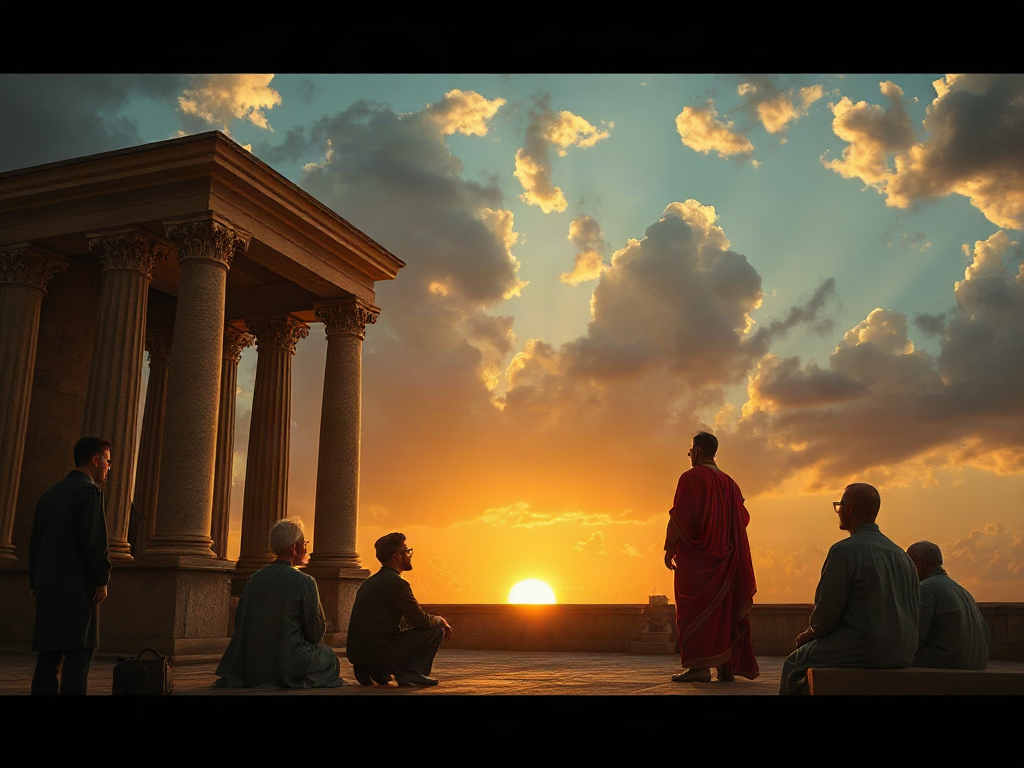

“World without end” in the KJV expresses unending duration rather than making a scientific claim that the present earth can never change. In Isaiah 45:17, it emphasizes the lasting salvation and freedom from shame promised to Israel; in Ephesians 3:21, it describes glory given to God through Christ and the church throughout every generation and age. The wording reflects older English usage in which “world” could refer to an age, enduring order, or continuing course of time. Readers should therefore examine the Hebrew or Greek expression, the immediate sentence, and the book’s wider teaching instead of imposing the modern sense of “planet” on the phrase.
Where “World Without End” Appears in the KJV
The exact wording “world without end” appears in two notably different settings in the King James Version. Isaiah 45:17 says that Israel shall be saved in the Lord with an everlasting salvation and shall not be ashamed or confounded “world without end.” Ephesians 3:21 gives glory to God in the church by Christ Jesus “throughout all ages, world without end.” The phrase serves a related purpose in both places: it carries the reader’s attention beyond a temporary event toward permanence.
Those two occurrences should not be flattened into a single, context-free definition. Isaiah is speaking within a prophetic declaration about the Lord as the unique Creator and Savior. Ephesians closes a prayer about divine power, Christ’s indwelling presence, spiritual comprehension, and the fullness of God. Isaiah applies enduring language to salvation and the removal of disgrace; Paul applies it to the praise owed to God across generations.
The practical starting point is to read the entire sentence containing the phrase. In Isaiah, “everlasting salvation” immediately controls how “world without end” should be heard. In Ephesians, the preceding words “throughout all ages” already identify duration as the issue. Neither passage is primarily discussing astronomy, geology, or the physical survival of the present planetary order.
A common mistake is to isolate the four English words and treat them as a technical statement about the earth. That approach gives modern English priority over grammar and context. The KJV uses “world” in several ways, and its meaning must be determined passage by passage. It can denote humanity, an ordered system, an age, or the inhabited creation, depending on the underlying language and subject.
Readers comparing the passages can use World Without End in the KJV: Meaning and Context as a focused study question: What is said to endure, and how does the surrounding sentence identify it? In Isaiah, the answer is the Lord’s saving work and its vindication. In Ephesians, it is the glory rendered to God through successive generations and ages.
What the Phrase Meant in Earlier English
In older English, “world” did not always mean the physical globe. It could describe an age, a state of affairs, the human order, or an indefinitely continuing course of life. “Without end” then intensified that temporal sense. A seventeenth-century reader could hear “world without end” as a conventional expression for perpetuity, comparable to saying “forever and ever.”
This historical usage matters because familiar words can conceal changes in meaning. Modern readers usually picture the planet when they encounter “world.” If that assumption is carried directly into the KJV, the phrase may appear to conflict with passages describing the heavens and earth passing away, creation being changed, or a new heaven and new earth. The apparent conflict is reduced once “world” is recognized as part of an idiom about enduring time.
The translators were not necessarily claiming that the underlying Hebrew and Greek used a noun with exactly the same modern range as “world.” Translation often expresses a source-language construction through a natural phrase in the receiving language. Isaiah uses an emphatic Hebrew expression of lasting duration. Ephesians contains a layered Greek construction that links generations and ages. The KJV’s “world without end” renders the force of continuation, not a standalone doctrine that the current world order remains unchanged forever.
Newer translations often make that temporal force more explicit with wording such as “forevermore,” “to all generations,” or “for all eternity.” Such renderings can help a present-day reader, but they do not make the KJV meaningless or erroneous. They reflect a change in ordinary English usage and different choices about how literally to reproduce repeated age-language.
The best comparison does not ask which English version sounds most dramatic. It asks whether each rendering communicates the role of the original expression in its sentence. Consulting several translations can expose where language has shifted, while a Hebrew or Greek interlinear can show the underlying construction. Lexicons are useful at that stage, but choosing the first dictionary gloss without considering syntax merely replaces one form of isolation with another.
Isaiah 45:17 and Everlasting Salvation
Isaiah 45:17 places the phrase inside a contrast between powerless idols and the Lord’s effective salvation. The chapter presents the God of Israel as Creator, ruler of history, and the only Savior. Nations and idol-makers face shame, but Israel is promised salvation “with an everlasting salvation.” The following assurance that Israel will not be ashamed or confounded “world without end” reinforces the permanence of that reversal.
The immediate issue is therefore not whether members of Israel ever experience earthly embarrassment. Isaiah speaks on the larger horizon of God’s covenant purpose and ultimate vindication. Temporary circumstances may include exile, political weakness, or public humiliation, yet those conditions do not overturn the promised outcome. The language looks beyond present appearances to a salvation that will not expire or be exposed as false.
Consider a reader who treats the final clause as an isolated guarantee that no believer will ever feel shame. That interpretation fails when measured against both experience and the passage itself. Isaiah has just described idolaters being ashamed together, while distinguishing the lasting destiny of those saved by the Lord. The contrast concerns ultimate standing and outcome, not the elimination of every painful emotion or public setback before fulfillment.
Another weak reading turns the verse into an unconditional statement about every individual associated with Israel, regardless of the chapter’s theological emphasis on turning to the Lord. Isaiah 45:22 calls the ends of the earth to look to God and be saved. The chapter joins divine uniqueness, universal invitation, and enduring rescue. Its confidence rests in the identity and action of the Savior, not in human strength or national prestige.
For practical interpretation, underline the paired expressions “everlasting salvation” and “world without end.” They explain one another. Then trace the chapter’s repeated claims that there is no God and Savior besides the Lord. This procedure keeps the promise attached to its stated foundation. A fuller study of World Without End in the KJV: Meaning and Context should preserve that connection between lasting salvation, freedom from final disgrace, and the Lord’s exclusive saving authority.
Ephesians 3:21 and Glory Through All Ages
Ephesians 3:21 is a doxology, a formal expression of praise at the end of Paul’s prayer. Paul has asked that believers be strengthened by God’s Spirit, that Christ dwell in their hearts by faith, and that they comprehend the vast dimensions of Christ’s love. After declaring that God can do beyond what believers ask or think, he directs glory to God “in the church by Christ Jesus throughout all ages, world without end.”
The phrase expands praise across both generations and ages. “Throughout all ages” already supplies a temporal frame, while “world without end” pushes that frame as far as language can carry it. Paul is not predicting that every local congregation will remain institutionally unchanged. Churches may close, divide, relocate, or lose faithfulness. His claim concerns God’s enduring glory in relation to the church and Christ Jesus, not the guaranteed survival of each human organization.
The order of the wording also deserves attention. Glory is directed to God, and Christ is central to how that glory is displayed. The church is not presented as an independent object of admiration. It is the redeemed community within which God’s wisdom, power, and grace become visible through Christ. Reading the verse as institutional self-congratulation reverses the direction of the doxology.
A modern congregation might quote Ephesians 3:21 during worship, an anniversary, or a prayer for future generations. The verse appropriately widens attention beyond the congregation’s immediate plans. Yet it should not be used to imply that a building project, ministry method, or denominational structure carries eternal authorization. The enduring element is God’s glory through Christ, not every strategy adopted in the church’s name.
Readers should connect verse 21 with Ephesians 3:20 rather than quoting either half alone. God’s ability to act beyond human asking leads to praise, not to a blank promise that every request will be granted in the form desired. Signs of a sound reading include greater attention to God, Christ, the church’s calling, and future generations. A reading is failing when it makes the verse primarily about personal achievement, institutional permanence, or unlimited claims detached from Paul’s prayer.
How to Interpret the Phrase Without Common Mistakes
A reliable interpretation begins with the object of the enduring language. Ask what the passage actually says will continue: salvation and vindication in Isaiah, or glory to God through Christ and the church in Ephesians. This check prevents a poetic expression of permanence from becoming a claim about a subject the author was not addressing.
Use the following compact sequence when studying either verse:
- Read the paragraph and chapter. Identify the argument, prayer, prophecy, or praise surrounding the phrase.
- Mark the nearby duration words. “Everlasting salvation” in Isaiah and “throughout all ages” in Ephesians clarify the idiom.
- Compare several translations. Notice whether they use “forever,” “forevermore,” “all generations,” or similar time-language.
- Check the original-language construction. Use an interlinear and a reputable lexicon, but interpret individual terms within their grammatical phrase.
- Test the conclusion against the book. A proposed meaning should fit Isaiah’s message about the Lord’s salvation or Ephesians’ teaching about God’s glory in Christ.
One frequent failure is word-study overreach. A reader may find that a Hebrew or Greek term has several possible senses and then import all of them into one verse. Words acquire their operative sense from usage. A broad lexical range is not permission to select whichever definition supports a preferred doctrine.
The opposite failure is refusing all translation comparison because the KJV wording is familiar. Respect for the KJV does not require treating seventeenth-century English as though its vocabulary were identical to present usage. Comparison can clarify what the KJV translators communicated to their first readers. It also helps distinguish a genuine theological disagreement from a simple difference in idiom.
Claims about the future earth should be built from passages that directly address creation’s destiny, resurrection, judgment, and the new heavens and new earth. “World without end” can contribute to a theology of permanence, but it should not carry that entire discussion by itself. The phrase’s local function is more precise: it assures readers of salvation that does not collapse and praise that does not reach an expiration point.
Frequently Asked Questions
How many times does “world without end” appear in the KJV?
The exact phrase appears twice: Isaiah 45:17 and Ephesians 3:21. Each occurrence uses enduring language, but Isaiah applies it to salvation and freedom from final shame, while Ephesians applies it to glory given to God across all ages.
Does “world without end” mean the earth will never be destroyed?
Not by itself. In these passages, the phrase functions as an idiom for unending duration. Questions about the earth’s future must be evaluated from biblical passages that address creation’s renewal or transformation directly.
Why do modern Bible translations use different wording?
Modern versions often use “forever,” “forevermore,” or language about all generations because “world without end” is no longer a common English expression. The newer wording aims to communicate the temporal force more directly.
What does Isaiah 45:17 promise?
It promises enduring salvation in the Lord and ultimate freedom from shame or defeat. The verse emphasizes the reliability of God’s saving purpose rather than exemption from every temporary hardship or embarrassing experience.
What does Ephesians 3:21 teach about the church?
It presents the church as the community in which glory is directed to God through Christ across generations. It does not guarantee that every congregation, institution, building, or ministry method will continue unchanged.
Conclusion
“World without end” should be read as enduring time-language shaped by older English and clarified by its immediate setting. Isaiah 45:17 anchors the expression in everlasting salvation and ultimate vindication. Ephesians 3:21 places it within praise offered to God through Christ across every generation and age. Neither verse is designed as an isolated explanation of the planet’s physical future.
The most dependable next step is simple: read each full chapter, mark the nearby duration terms, and compare a few responsible translations. Consult original-language tools only after identifying the sentence’s subject and purpose. That order keeps lexical details under the control of context. It also avoids the two most common errors—forcing the modern planetary sense of “world” into the phrase or making one older English idiom settle every biblical question about eternity and creation.