
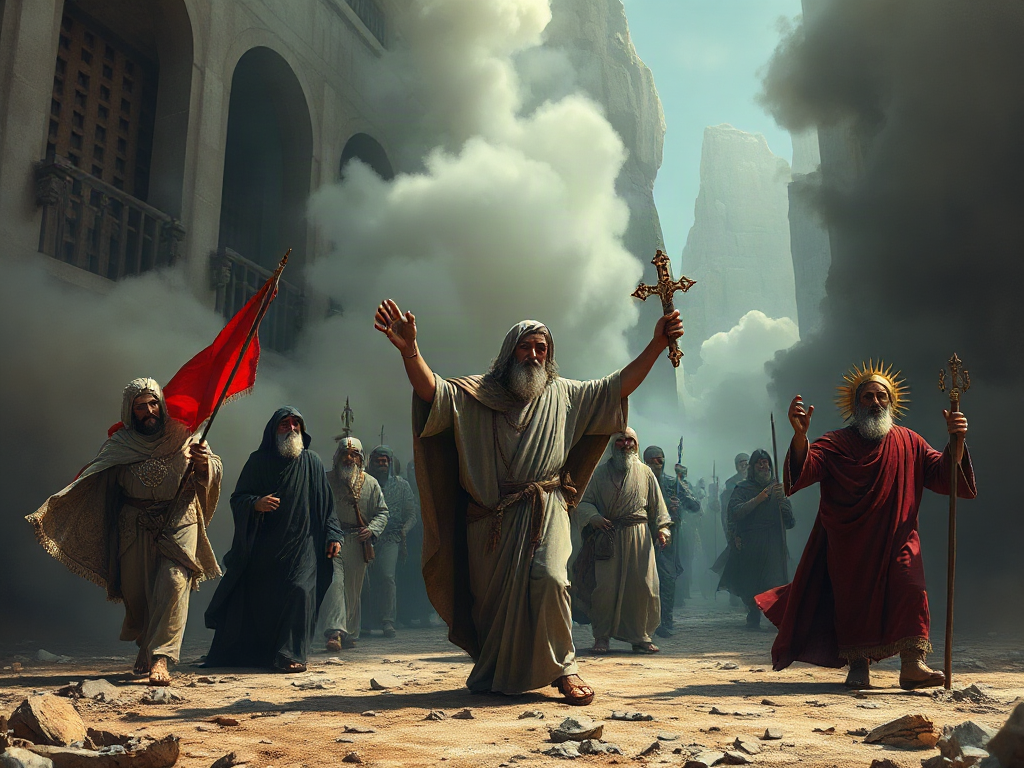
Jesus presents false christs as deceptive claimants who appropriate messianic authority, exploit periods of upheaval, and try to redirect allegiance away from his own words. In Matthew 24, Mark 13, and Luke 21, their warning signs include claims such as “I am he,” reports that the Messiah has appeared at a secret location, and impressive signs used to validate a false identity. Jesus tells disciples not to follow them, not to rush after sensational reports, and not to treat wars or disturbances as proof that the end has arrived immediately. Discernment therefore rests on Jesus’ prior warning, the public character of his return, and faithful endurance rather than charisma or urgency.
Where Jesus Warns About False Christs
Jesus’ principal warnings appear in the Olivet Discourse, recorded in Matthew 24, Mark 13, and Luke 21. The discourse begins after Jesus predicts the destruction of the temple. His disciples then ask about the timing and signs connected with these events. Before describing wars, persecution, upheaval, or his coming, Jesus makes deception the first danger they must recognize.
Matthew 24:4–5 reports Jesus warning that many will come in his name and say, “I am the Christ.” Mark 13:5–6 gives a closely related form, while Luke 21:8 includes the claims “I am he” and “The time is near.” Luke’s wording joins a claim to personal authority with a claim to possess the prophetic timetable. Jesus’ instruction is unambiguous: “Do not go after them.” The disciples are not asked to investigate every claimant or wait for more impressive proof before withholding allegiance.
The warning becomes more specific later in Matthew 24:23–26 and Mark 13:21–23. People may announce that the Christ is “here” or “there,” perhaps in the wilderness or an inner room. False christs and false prophets may also produce signs and wonders calculated to mislead. The danger is therefore more than a person using a messianic title. It includes a network of testimony, spectacle, location claims, and prophetic interpretation that makes the claimant appear credible.
The Greek term translated “false christs” or “false messiahs” refers to counterfeit anointed figures. Jesus’ audience knew that “Christ” was a title, not Jesus’ surname. A claimant could therefore present himself as Israel’s promised ruler, a divinely appointed deliverer, or the decisive agent through whom God would act. Readers should retain that historical meaning rather than reducing the warning to any teacher with an incorrect doctrine.
At the same time, the text’s principle extends beyond someone literally announcing, “I am Jesus.” A leader who demands the trust, obedience, or redemptive expectation belonging to the Messiah may reproduce the underlying deception without using the exact title. Careful study of False christs in Jesus’ end-times teaching should begin with these Gospel passages and then distinguish their direct referents from responsible contemporary application.
How the Deception Works
False-messiah deception works by attaching extraordinary claims to conditions in which people urgently want certainty and deliverance. Jesus places the warning amid conflict, rumors, persecution, betrayal, and social disruption. Such pressures can make confident claims feel persuasive before their truth has been tested. A leader who promises immediate rescue or announces privileged knowledge can turn public anxiety into personal authority.
Luke identifies two complementary claims: “I am he” and “The time is near.” The first centers authority in a person; the second creates urgency around that authority. Together they discourage patient judgment. If listeners believe history has reached its final hour and only one claimant understands what God is doing, hesitation may be portrayed as unbelief. Jesus breaks that pressure by telling his followers not to go after such people and by stating that upheaval does not mean the end follows immediately.
Matthew adds claims about hidden geography: the Christ is supposedly in the wilderness or in an inner room. These reports conflict with Jesus’ comparison of his coming to lightning visible from east to west. The contrast matters. A secret appearance depends on intermediaries who say where the Messiah can be found, while the coming Jesus describes will not need promoters to authenticate an obscure location. The public character of that event undercuts attempts to manufacture exclusivity.
Signs and wonders create a further test because an impressive event does not establish the identity assigned to it. Matthew 24:24 does not invite disciples to dismiss every unusual report without inquiry; it denies that spectacle is a sufficient credential. A sign can be misunderstood, exaggerated, staged, or interpreted through a false claim. Even where an event appears extraordinary, the central question remains whether the claimant agrees with Jesus’ teaching and identity.
A practical scenario illustrates the mechanism. Suppose a leader announces that worldwide instability proves the final timetable has begun, claims a unique divine appointment, and tells followers to gather at a particular place for protection. Reports of healings or predictions are then offered as proof. Each element may reinforce the others: crisis validates the timetable, the timetable elevates the leader, and reported wonders protect the leader from scrutiny. Jesus’ sequence reverses that logic. His prior warning evaluates the claimant; the claimant does not gain authority to reinterpret the warning.
The common mistake is to focus only on whether someone uses the word “Christ.” The more revealing pattern is the combined demand for messianic allegiance, timetable certainty, secret access, and immunity from testing. That pattern provides a more text-sensitive account of the warning than merely labeling every theological opponent a false christ.
Tests Jesus Gives His Disciples
Jesus gives his disciples a compact set of tests centered on allegiance, publicity, timing, and endurance. These are not techniques for calculating a date. They are safeguards against being moved by a claimant whose authority depends on excitement, fear, or restricted information.
First, test the allegiance being demanded. A false christ does not merely offer an opinion; the claimant seeks the place owed to God’s appointed Messiah. Readers should ask whether a person is demanding unquestioning loyalty, treating access to himself as necessary for salvation or safety, or displacing Jesus’ recorded commands with fresh private instructions.
Second, compare secret-location claims with Jesus’ description of his coming. Matthew’s lightning image presents visibility rather than concealment. A message such as “Only our group knows where Christ has appeared” resembles the report Jesus specifically tells disciples not to believe. The appropriate response is not a pilgrimage to verify the location but refusal to grant the report authority.
Third, separate turmoil from timetable certainty. Wars, disturbances, famines, earthquakes, and persecution are serious, but Jesus warns against turning them into proof that the end has arrived at once. A teacher may discuss their place in the discourse; the problem begins when uncertainty is concealed and current events are used to make an exclusive claim unavoidable.
Fourth, refuse to let wonders override the message. Claims of miracles should not be treated as self-interpreting evidence. Ask what conclusion followers are being pressured to draw, whether independent verification exists, and whether the reported sign is being used to excuse contradictions with Jesus’ teaching. A failed prediction, concealed evidence, or constantly revised explanation indicates that the claim is being protected rather than tested.
A concise discernment check can help readers respond without becoming consumed by every rumor:
- Identify the exact identity and authority being claimed.
- Read Matthew 24, Mark 13, and Luke 21 in their full narrative settings.
- Note whether urgency is being used to prevent questions or outside counsel.
- Reject secret appearances and date claims that contradict Jesus’ stated cautions.
- Judge signs within the claimant’s complete message, conduct, and demands.
This approach is working when it produces textual clarity, measured judgment, and continued faithfulness. It is failing when every headline becomes a prophetic proof, disagreement is treated as disloyalty, or a charismatic figure becomes the lens through which Jesus’ words are rewritten. The aim of False christs in Jesus’ end-times teaching is not endless suspicion; it is resistance to misplaced allegiance.
Interpretive Questions and Common Mistakes
The discourse addresses events near the disciples’ own horizon while also using language associated with the coming of the Son of Man, which has produced several major interpretive approaches. Some readers emphasize the first-century setting and connect deceptive claimants with turmoil surrounding Jerusalem and the temple’s destruction. Others understand much of the warning as awaiting a future period immediately before Christ’s return. Still others see an initial historical fulfillment that anticipates a final culmination.
These views differ over chronology, but they need not erase the shared force of Jesus’ command. The disciples are warned against claimants, false reports, and premature declarations of the end. A responsible interpretation should explain what the warning meant to its first hearers before moving to later application. Conversely, restricting every line so tightly to the first century that it has no continuing relevance may overlook the discourse’s call for watchfulness and endurance.
Another mistake is merging “false christs,” “false prophets,” and “the antichrist” into one undefined category. The false christs and false prophets occur in Jesus’ Gospel discourse. The term “antichrist” appears in the letters of John, where it is connected with denial concerning Jesus and with deceivers already active. Paul’s “man of lawlessness” and Revelation’s beasts belong to still other textual settings. The figures may be compared within a broader theology of deception, but they should not be treated as interchangeable labels without argument.
Readers also sometimes use “false christ” as a weapon against any pastor, denomination, or political figure they distrust. That move weakens the precision of the warning. Serious doctrinal error, abusive leadership, false prophecy, and a counterfeit messianic claim can overlap, but they are not identical. Naming the specific problem makes correction more accurate and reduces the risk of sensational accusation.
The opposite error is assuming modern people are too sophisticated to follow a messianic claimant. A person need not wear ancient clothing or use traditional religious vocabulary. Political rescue, spiritual elitism, prophetic certainty, or claims of unique access can provide modern forms for an old demand. Application should remain controlled by the text: not every influential leader is a false christ, but no leader should receive the identity, final authority, or saving trust assigned to Christ.
A sound interpretation states its chronological assumptions, distinguishes related biblical terms, and preserves Jesus’ practical command. Where interpreters disagree about fulfillment, they can still agree that sensational confidence is not a substitute for close reading and that no proposed timeline authorizes following a counterfeit deliverer.
Applying the Warning Without Feeding Speculation
Faithful application begins with reading the entire discourse rather than collecting isolated phrases from current events. Matthew 24, Mark 13, and Luke 21 share substantial material, but each Gospel has distinctive wording and emphasis. Comparing them exposes claims built on a fragment while also showing the repeated commands: do not be led astray, do not follow false claimants, do not panic, and remain steadfast.
When a new messianic or prophetic claim appears, record the claimant’s own words before reacting to commentary about them. Determine whether the person actually claims to be Christ, a divinely appointed final deliverer, or the exclusive interpreter of the end. Then examine what followers are expected to do. Requests for money, relocation, separation from family, secrecy, surrender of property, or refusal of outside information raise practical risks even before every theological question is settled.
Pastors, families, and small groups should respond differently to curiosity and entanglement. Someone asking about an online rumor may need a calm comparison with the Gospel text. Someone already isolated inside a controlling group may need patient contact and attention to immediate safety, finances, housing, and relationships. Ridicule can deepen dependence on the claimant by confirming the group’s story that outsiders are hostile. Clear questions and preserved lines of communication are usually more constructive than a public argument.
Claims that depend on a date deserve written tracking. Record what was predicted, when it was supposed to occur, and whether the explanation changes afterward. Repeated revisions are a sign that the system is insulating itself from correction. By contrast, healthy biblical teaching acknowledges interpretive limits, permits examination of claims, and does not make loyalty to a present leader the condition of belonging to Christ.
Readers should also avoid turning discernment into constant rumor monitoring. Jesus’ instruction directs attention toward durable obedience and endurance, not fascination with every possible deceiver. A useful study of False christs in Jesus’ end-times teaching should leave a person better able to recognize misplaced authority while remaining anchored in the Gospels.
The practical priority is straightforward: know what Jesus actually said before evaluating what others say about his return. Signs that this discipline is working include less susceptibility to urgent claims, greater willingness to check context, and clearer separation between Christ’s authority and a leader’s interpretation. Signs of failure include compulsive date-setting, secret knowledge, escalating demands, and the belief that one present-day figure cannot be questioned.
Frequently Asked Questions
What does “false christs” mean in Matthew 24?
The expression means counterfeit messiahs: people claiming the identity or authority of God’s anointed deliverer. The immediate context includes personal claims, deceptive signs, and reports that the Messiah has appeared at a particular location.
Are false christs the same as false prophets?
Not exactly. A false christ claims messianic identity or authority, while a false prophet claims to speak for God. Jesus mentions them together because false prophecy and reported wonders can support a counterfeit messianic claim.
Did Jesus say miracles prove that someone is the Messiah?
No. Jesus warns that false christs and false prophets may present impressive signs. A reported wonder must not override his teaching, his identity, or his description of how his coming will be recognized.
Does every crisis mean a false christ will appear immediately?
No. Jesus mentions turmoil while warning disciples not to be alarmed or conclude that the end follows at once. Crises can create conditions that deceptive leaders exploit, but they do not validate a claimant or timetable.
How should Christians respond to a modern messianic claimant?
They should compare the claim with the Gospel accounts, refuse demands for messianic allegiance, document predictions, and avoid secret-location or date-setting pressure. If a controlling group creates financial, relational, or physical danger, practical safety should receive prompt attention.
Further Reading
Authoritative Sources
- Matthew 24
biblegateway.comThe complete chapter provides the immediate setting for Jesus’ warnings about false messiahs, deceptive signs, secret appearances, and the coming of the Son of Man
- Mark 13
biblegateway.comMark’s parallel account helps readers identify the wording shared across the Gospel tradition and the commands directed to the disciples
- Luke 21
biblegateway.comLuke connects false identity claims with declarations that the time is near and records Jesus’ instruction not to follow the claimants
- NET Bible: Matthew 24
netbible.orgThe NET Bible offers the biblical text with translation notes useful for examining important wording in the discourse
Conclusion
Jesus’ warning directs attention away from sensational claimants and back to his own prior instruction. Readers should examine the authority a leader claims, the urgency used to secure obedience, the role assigned to signs, and any promise of secret access to the Messiah. The Gospel accounts do not authorize confident date-setting or panic whenever conflict intensifies; they call for alertness joined to endurance.
Interpretive disagreements about the discourse’s chronology should be acknowledged rather than hidden, but they do not cancel its practical safeguards. Read Matthew 24 beside Mark 13 and Luke 21, keep related biblical figures distinct, and test modern applications against the actual wording and context. Where a claimant pressures followers to isolate, relocate, surrender resources, or reject scrutiny, address both the theological error and the concrete risks. The next step is careful comparison, not hurried allegiance.